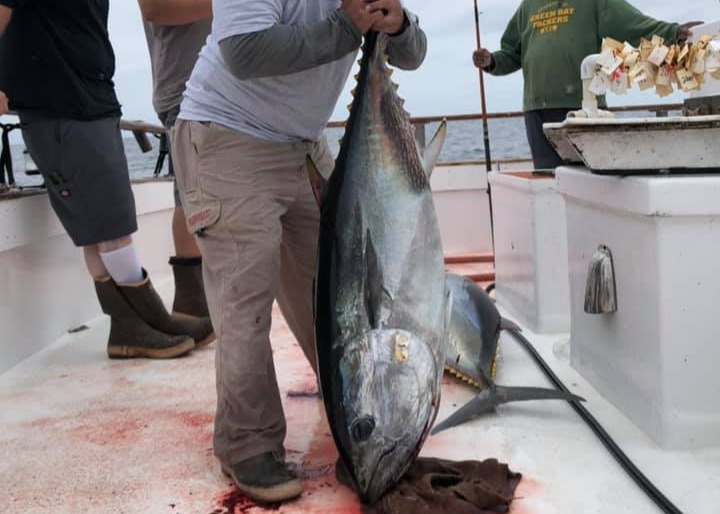
Pacific bluefin tuna are the most sought-after gamefish in Southern California, and water temperature is one of the best predictors of where you’ll find them. Unlike most pelagic species that need warm tropical water, bluefin are cold-water tolerant and will feed in a surprisingly wide temperature range — which is exactly why they show up off San Diego when other warm-water species haven’t arrived yet.
Here’s what you need to know about bluefin tuna and water temperature to plan your next trip.
The Quick Answer: Ideal Temperature Range
Bluefin tuna are most actively caught in water temperatures between 60°F and 72°F (15.5–22°C). The sweet spot for Southern California is 62–68°F, which is when the fish are feeding aggressively and most accessible to the sportfishing fleet.
That said, bluefin have been caught in water as cold as 55°F and as warm as 78°F off our coast. Their ability to thermoregulate — maintaining a body temperature above ambient water — gives them a much wider range than yellowfin or dorado. This is a key reason bluefin can be targeted nearly year-round in SoCal and Baja waters.
Temperature Ranges and What to Expect
The Prime Zone: 62–68°F
This is the bread-and-butter range for SoCal bluefin fishing. In this range, bluefin are typically:
- Feeding on the surface or in the upper water column
- Responsive to flylined bait and topwater techniques like surface iron and poppers
- Holding on temperature breaks and along current edges
- Found in schools mixing smaller 20–40 lb fish with occasional larger specimens
When you see this range on the SST chart, pay close attention to where the 62°F and 68°F isotherms sit relative to known banks and structure.
Cool Side: 58–62°F
Bluefin absolutely feed in the low 60s and upper 50s, but the bite changes character. Fish in cooler water tend to be:
- Deeper in the water column (50–150 feet down)
- More responsive to kite fishing, slow-trolled mackerel, and deep jigging with flat-falls
- Less likely to show on the surface or feed on flylined sardines
- Often larger-grade fish — winter/spring giants in the 100–300 lb class
Don’t write off a trip just because the SST chart shows 59°F. Some of the biggest bluefin caught off San Diego have come in water that would send yellowtail south.
Warm Side: 68–74°F
As water pushes into the upper 60s and low 70s — typically late summer through fall — bluefin often share the water with yellowfin tuna, dorado, and wahoo. In this range:
- Bluefin may become more selective and harder to hook as bait options increase
- Surface iron, poppers, and trolled lures become more effective
- Fish often push to deeper, cooler pockets below the thermocline while feeding up on bait schools
- Mixed bags are common — you might hook bluefin, yellowfin, and dorado on the same stop
Extended Range: Below 58°F or Above 74°F
Bluefin can be caught outside the typical range, but these are generally edge cases. Below 58°F, the fish are usually deep and scattered. Above 74°F, you’re more likely targeting yellowfin, with bluefin as an incidental catch around deeper structure or thermocline edges where cooler water sits below the warm surface layer.
Bluefin Temperature Preferences by Season in SoCal
Winter (December–February): 57–62°F
The conventional wisdom is that bluefin disappear in winter, but that’s not always true. In warmer years, fish linger off the Coronado Islands and outer banks in water around 60°F. These tend to be bigger fish — the kind that make multi-day trips worthwhile. Check the fleet tracker to see if boats are making the run south. If they are, the bluefin are still around.
Spring (March–May): 60–65°F
The bluefin season traditionally kicks off in spring as water temps climb past 60°F. Early-season fish often show up at the outer banks (9 Mile, 43 Fathom, Coronado Canyon) and along temperature breaks where warmer offshore water meets the cooler coastal upwelling. This is when SST charts become essential — a 2–3°F temperature break can concentrate bait and bluefin along a visible edge. See our guide on how to find temperature breaks for details. Have your bluefin reel spooled with fresh 50–65lb braid before the season starts.
Summer (June–August): 64–72°F
Peak season. The widest temperature range and most fish. Bluefin can be found from the local kelp beds out to San Clemente and Tanner Banks, often in massive schools. Surface feeding is common, and flyline bait fishing is at its best. The SST chart during summer usually shows a complex mix of warm and cool water masses — look for the edges and eddies where different water masses meet. Bring your iron setup for surface boils and a trolling spread for covering ground between stops.
Fall (September–November): 65–72°F
The water is at its warmest, and this is often when the biggest fish of the year are caught. Fall bluefin have been feeding all summer and can be at peak weight. Trophy fish over 200 lbs are most common in September and October. The SST charts may show the warmest surface temps of the year, but don’t be misled — bluefin will often sit just below the warm surface layer. Look for areas where the warm water is pushed up against cooler upwelled water, especially around the islands.
How to Use SST Charts to Find Bluefin
Water temperature is the starting point, not the whole picture. Here’s a practical workflow for using SST charts to narrow down where bluefin are likely to be:
- Check the regional SST chart — Look for water in the 60–72°F range within reach of the SoCal fleet (inner and outer banks, island waters, Baja coast)
- Find the temperature breaks — Bluefin stack up along edges where temperature changes 2°F or more over a short distance. These breaks concentrate bait and create feeding lanes.
- Cross-reference chlorophyll — Green water (high chlorophyll) means plankton, which means bait. Bluefin often work the edge where green productive water meets cleaner blue offshore water. Check the chlorophyll map — see our chlorophyll guide for how to read the edges.
- Watch the fleet — Use the fleet tracker to see where boats are fishing and how long they’re staying on a spot. Multiple boats holding position is a strong signal.
- Compare the 14-day animation — Conditions change fast. Use the animated SST view to see if a warm water mass is building, holding, or retreating. A stable, warm eddy that’s been in place for several days is more likely to hold fish than a transient warm spot.
Beyond Temperature: Other Factors That Matter
Water temperature gets you in the neighborhood. These factors help you narrow it down to the right block:
Bait presence — Bluefin follow their food. Sardines, anchovies, squid, and flying fish all drive bluefin movements. If you’re marking bait on the sounder in the right temperature range, you’re in the zone.
Water clarity — Bluefin generally prefer clean blue water over dirty green. The transition zone between blue and green (the “color break”) is often where the action is — see our chlorophyll map guide for identifying these edges from satellite data.
Current — Moving water concentrates bait. Tidal flow around structure, wind-driven currents, and larger oceanographic features like eddies all create feeding opportunities.
Moon phase — Some skippers swear by the new moon for bluefin, as darker nights may push fish to feed more aggressively during the day. Full moons can produce good night bites on kite-fished baits.
Time of day — Dawn and dusk are classic feeding windows. But surface-feeding bluefin on a flat-calm midday are not uncommon in peak season.
Bluefin Gear and Lure Guides
Once you’ve found the right water temperature, you need the right gear to land these fish. Bluefin pull harder than any other SoCal species — undersized tackle means lost fish. Here are our complete bluefin guides:
- Best Reel for Bluefin Tuna — 40lb+ class conventional and spinning reels
- Best Tuna Jigs — surface iron, flat-falls, yo-yo jigs, and casting jigs
- Best Lures for Tuna — trolling lures, cedar plugs, feathers, and casting lures
- Best Poppers for Tuna — when bluefin are blowing up on the surface
- Surface Iron Fishing Guide — casting technique, retrieval methods, and gear setup
- Best Hooks by Species — Owner circle hooks for live bait, ST-66 trebles for iron
- Circle Hooks vs J Hooks — when to use each on tuna
- Fly-Line Rig for Tuna — the most effective live bait technique
- Best 8-Foot Offshore Rods — preferred rod length for tuna iron
- Best Rod & Reel Combos for SoCal — complete setups by target species
- Braid vs Mono vs Fluorocarbon — why 50–65lb braid + fluoro leader is the standard
- Best Fishing Line by Pound Test — specific braid and leader recommendations
- Best Fishing Knots — FG knot for braid-to-fluoro connections
Quick Reference Table
| Temperature Range | Rating | What to Expect | Best Techniques |
|---|---|---|---|
| 55–58°F | Fishable | Deep, scattered fish; trophy potential | Deep jig, kite, slow-trolled mackerel |
| 58–62°F | Good | Early season; fish moving in; bigger grade | Kite, flyline with sinker, slow troll |
| 62–68°F ⭐ | Prime | Peak activity; surface feeding; best consistency | Flyline sardine, surface iron, poppers, troll |
| 68–72°F | Good | Late season; mixed with yellowfin/dorado; selective bite | Topwater, trolling, chunk, flyline |
| 72–78°F | Fishable | Fish often below thermocline; incidental catches | Deep jig, deep bait, thermocline edges |
Plan Your Trip
Planning a bluefin trip? Start by checking current conditions:
- SST Chart — Find the 62–68°F water and temperature breaks
- Chlorophyll Map — Find where bait is concentrating along the edges
- Marine Weather — Wind, swell, and offshore conditions
- Fleet Tracker — See where San Diego’s sportfishing boats are fishing right now
- AI Fishing Predictions — Our model combines SST, chlorophyll, swell, and historical catch data
- SD Fishing Season Calendar — When bluefin show up in SoCal
Related Guides
- Best Reel for Bluefin Tuna
- Best Tuna Jigs
- Best Lures for Tuna
- Best Poppers for Tuna
- Surface Iron Fishing Guide
- Jigs vs Irons vs Poppers
- Fly-Line Rig for Tuna
- Best Hooks by Species
- Circle Hooks vs J Hooks
- Best 8-Foot Offshore Rods
- Best 40lb Reels
- Best Rod & Reel Combos for SoCal
- Braid vs Mono vs Fluorocarbon
- Best Fishing Line by Pound Test
- Best Fishing Knots
- How to Read SST Charts
- Finding Temperature Breaks
- How to Use Chlorophyll Maps
- Best Water Temp for Yellowfin Tuna
- Best Water Temp for Dorado
- Best Water Temp for Yellowtail
- Best Water Temp for Wahoo
- Best Water Temp for White Seabass
- Best Water Temp for Halibut
- Best Lures for Dorado
- Best Yellowtail Jigs & Irons
- Overnight Trip Packing List
- SD Fishing Season Calendar
Tight lines!