• Understanding Upwelling

    Understanding Upwelling

    How Cold Water from Below Creates Hot Fishing Above

    Along the coasts of Baja and Southern California, some of the most productive fishing water doesn’t flow in from somewhere else — it rises up from below. This process, called upwelling, is responsible for the rich marine ecosystem that makes our region one of the best fisheries on the Pacific coast. Understanding how it works helps you predict where the bite will be — and what gear to have ready when you get there.

    The Mechanics of Upwelling

    Upwelling starts with wind. When prevailing winds blow parallel to the coastline, a phenomenon called Ekman transport pushes surface water offshore at an angle. As that surface water moves away from shore, cold water from depth rises to replace it.

    This deep water is fundamentally different from what was at the surface. It’s colder, often by 10 degrees or more, and it’s loaded with nutrients — nitrates, phosphates, and silicates that have accumulated in the deep from decomposing organic matter. When this nutrient-rich water hits the sunlit surface, it fertilizes an explosion of phytoplankton growth.

    That phytoplankton bloom feeds the entire food chain above it. Zooplankton multiply, baitfish arrive to graze, and gamefish follow the bait. A strong upwelling event can transform a biological desert into productive fishing grounds within a week.

    Where Upwelling Happens

    Upwelling isn’t uniform along the coast. It concentrates around specific geographic features.

    Headlands and points. Where the coastline juts out into prevailing winds, upwelling intensifies. Points like Punta Banda, Punta Colonet, and Cabo San Lucas are reliable upwelling hotspots. The cold, green water often extends offshore from these landmarks in visible plumes.

    Submarine canyons. Deep water close to shore makes it easier for upwelled water to reach the surface. Canyons act as conduits, channeling cold water upward along their walls. The edges of these canyons, where upwelled water meets ambient surface water, create distinct temperature breaks.

    Islands and banks. Offshore features can generate localized upwelling when currents flow past them. The downstream side of islands often shows cooler, more productive water. Seamounts and underwater ridges create similar effects — the same structure that generates upwelling also holds yellowtail and white seabass along the edges.

    Reading Upwelling on the Charts

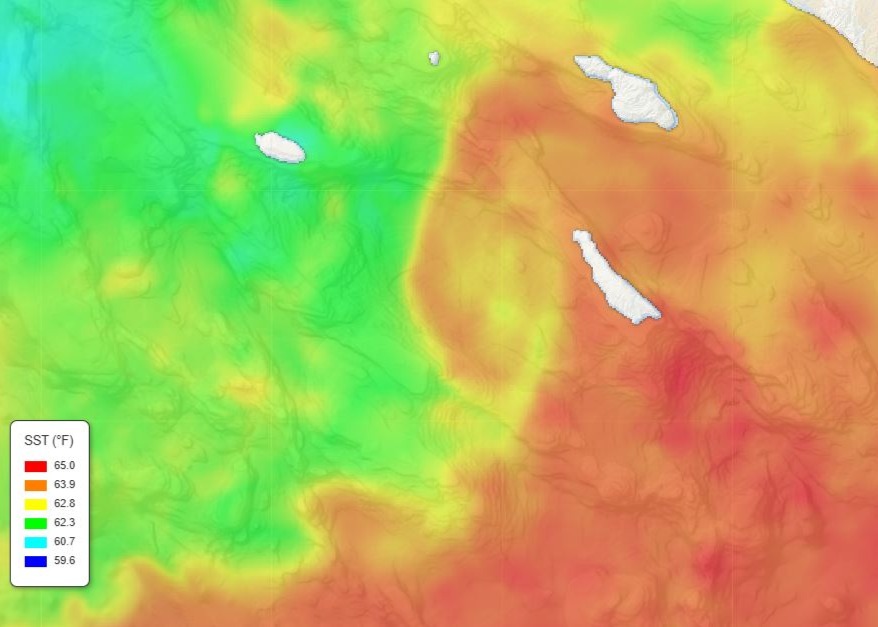
    On the SST chart, active upwelling appears as tongues of cold water extending from the coast or from bathymetric features. The color will be notably cooler than surrounding offshore water — often blue or purple against green or yellow backgrounds.

    The key features to look for:

    Sharp thermal gradients at the upwelling edge. Where the cold upwelled water meets warmer surface water, you get a distinct temperature break. This edge is prime fishing territory — bait concentrates there, and predators patrol it. See our fishing the edges guide for how to work these boundaries once you’re on the water.

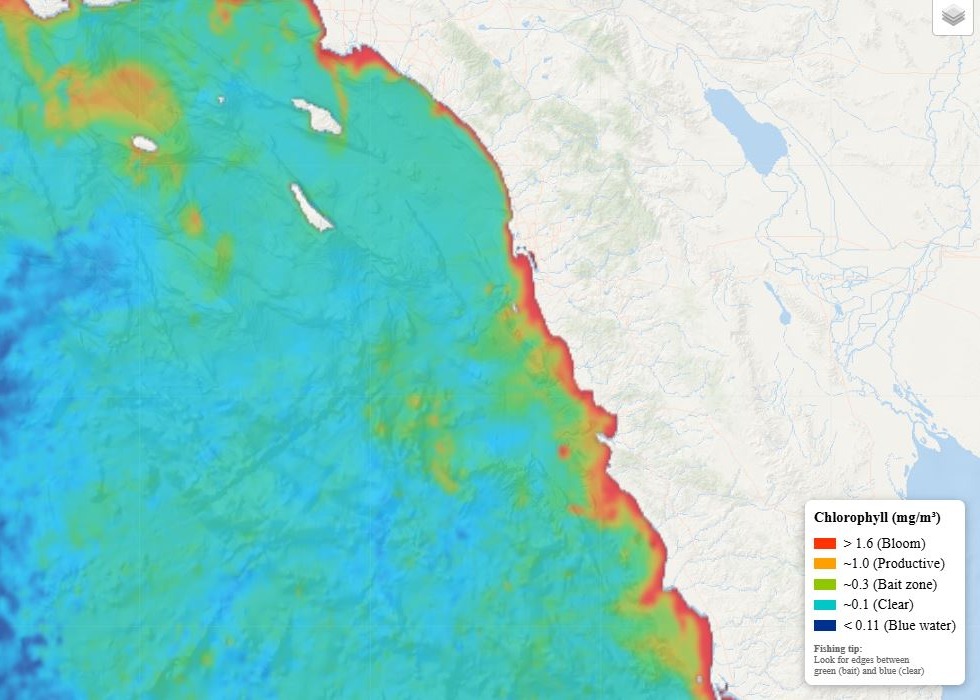
    Corresponding chlorophyll blooms. Flip to the chlorophyll map and look for elevated readings in the same area. Fresh upwelling might show cold water but low chlorophyll (the nutrients haven’t spurred a bloom yet). Mature upwelling shows both cold temps and high chlorophyll. Aging upwelling may show the chlorophyll persisting even as water temperatures moderate. See our chlorophyll map guide for how to read these patterns.

    Plume direction. Upwelled water gets pushed offshore and curves with the currents. Tracking where that plume extends helps you find productive edges further from the coast where fishing pressure is lighter.

    Timing the Upwelling Cycle

    Upwelling events follow a cycle that directly impacts fishing quality.

    Days 1–2: Fresh upwelling. Water temps drop sharply, but chlorophyll hasn’t responded yet. Bait may scatter as conditions change rapidly. Fishing can be tough — you have cold, clear water without an established food chain.

    Days 3–5: Building productivity. Phytoplankton respond to the nutrients. Chlorophyll levels climb. Zooplankton populations grow. Bait begins concentrating along the upwelling edges. Fishing improves.

    Days 5–10: Peak conditions. The full food chain is operating. Bait is stacked on the edges, gamefish are actively feeding. Temperature breaks are well-defined. This is the window you want to hit.

    Days 10+: Relaxation. Winds shift, upwelling weakens, surface water warms. The bloom may persist, but the sharp edges soften. Fishing remains decent but becomes less predictable.

    Watching the multi-day trend on the SST chart animation helps you catch the upwelling cycle at its peak rather than arriving too early or too late.

    Which Species Benefit from Upwelling

    Different species relate to upwelling differently. Knowing where each one sits in the upwelling picture tells you what to target — and what gear to bring:

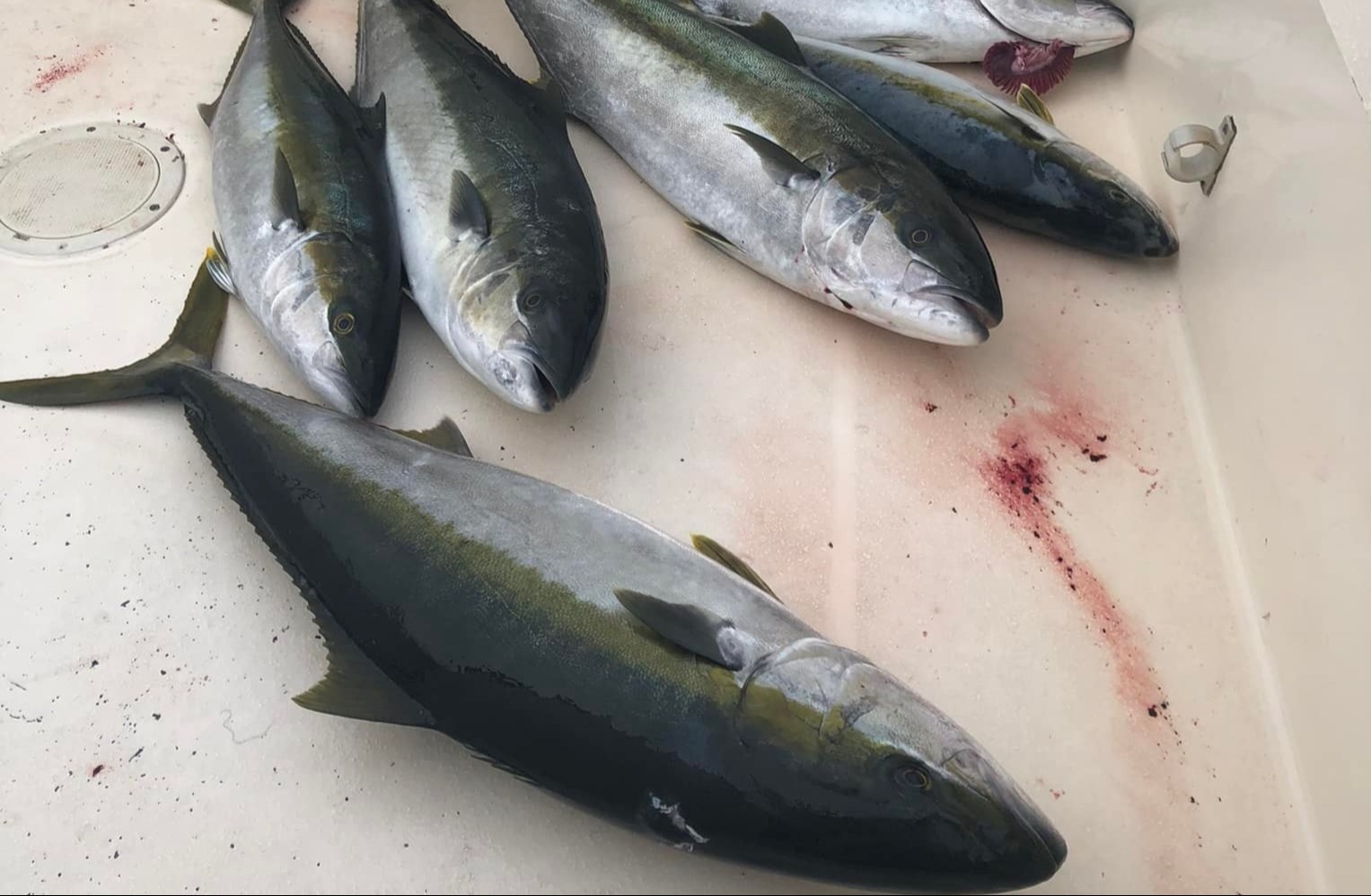
    Yellowtail push up the coast following bait that concentrates along upwelling edges, especially in spring. They feed comfortably in the greener, productive water and don’t avoid it like tuna do. Upwelling zones near islands and reefs are yellowtail magnets. Bring your iron and jigs — the Tady 45 for surface boils, flat-falls for fish on deep structure. A 30lb class setup covers it.

    White seabass thrive in upwelling conditions. The cold, nutrient-rich water triggers squid spawning runs, and white seabass follow the squid into the kelp. When you see mature upwelling (cold water + high chlorophyll) near kelp beds in 58–65°F water during spring, that’s white seabass territory. Fish the kelp edges at dawn with a slider rig and live squid on a 4/0–6/0 circle hook.

    Bluefin tuna work the outer edges of upwelling plumes — where the cold productive water meets warmer offshore water. They stage in the cleaner water and dart into the green side to feed. Look for upwelling edges where temperature hits the 62–68°F sweet spot. Have your tuna setup rigged with 50–65lb braid and iron ready.

    Halibut respond to nearshore upwelling that pushes bait onto sandy flats. When the SST chart shows upwelling bringing water into the upper 50s to low 60s along the coast, halibut move shallow to feed. Swimbaits and Carolina rigs on the sandy flats produce best during these events.

    Dorado and yellowfin prefer the warm, clean side — they avoid the upwelling core but feed along its outer boundary where kelp paddies and debris collect along the current edge. Run a trolling spreadcedar plugs and feathers — along the warm side of the upwelling edge.

    Seasonal Patterns

    Spring (March–May) is the classic upwelling season along the Baja and SoCal coast. Northwest winds strengthen, and regular upwelling events create the productivity that fuels summer fishing. This is when yellowtail push up the coast following the bait, white seabass move into the kelp for squid, and early-season bluefin show up along the outer edges.

    Summer (June–August) sees reduced but localized upwelling. Look for persistent cold spots around known features — these become magnets for bait and fish when surrounding water gets warm and sterile. The contrast between upwelling zones and the warm offshore water creates some of the sharpest temperature breaks of the year.

    Fall (September–November) brings variable conditions. Wind patterns shift, and upwelling becomes less predictable. But fall upwelling events, when they happen, can produce excellent fishing as fish feed heavily before water cools.

    Winter (December–February) generally has the weakest upwelling, but some localized events occur during Santa Ana wind patterns when offshore flow reverses the typical direction. Check the SST chart during and after Santa Ana events — the wind-driven mixing can create unexpected productive zones.

    Practical Application

    Before planning a trip, review several days of SST charts to identify active upwelling zones. Look for cold-water plumes extending from known headlands or structure. Check if those same areas show elevated chlorophyll on the chlorophyll map — that tells you the upwelling has matured enough to build a food chain.

    Target the edges of the upwelling plume rather than the coldest water at its core. The core might be too cold for your target species, while the edges offer the combination of nutrients, bait, and comfortable temperatures that stack fish. See our fishing the edges guide for how to work these boundaries effectively.

    Upwelling is the engine that drives productivity in our coastal waters. Learn to read it on the charts, and you’ll understand why certain spots fire while others stay quiet — and you’ll know where to be when conditions come together.

    Plan Your Trip

    Read the upwelling before you leave the dock:

    Related Guides

    Tight lines!

  • Best Water Temperature for Yellowtail Fishing

    Best Water Temperature for Yellowtail Fishing

    Yellowtail and Water Temperature

    California yellowtail (Seriola dorsalis) are one of the most temperature-sensitive gamefish on the West Coast. They’re warm-water fish with cold-water tolerance, which makes them uniquely responsive to the temperature patterns you can see on SST charts. Understanding their preferred temperature ranges — and how those preferences shift with the seasons — will put you on fish more consistently than any other single factor.

    Whether you’re fishing from a party boat out of San Diego or running a private boat to the islands, water temperature is the first thing to check before committing to a plan.

    The Magic Numbers

    Yellowtail along the Southern California and Baja coast generally bite best in a specific temperature window:

    Prime range: 62°F – 70°F

    This is where the majority of yellowtail action happens from San Diego to Cedros Island. Within this window, the fish are active, feeding aggressively, and willing to chase surface iron, yo-yo jigs, and live bait. Most captains will tell you that 64–68°F is the sweet spot.

    Fishable range: 58°F – 74°F

    Yellowtail can be caught outside the prime window. In winter, fish around the Coronado Islands and Colonet will bite in water as cool as 58°F, though they tend to be sluggish and deeper. In summer, fish at Guadalupe Island or the warmer Baja banks will feed in water up to 74°F, particularly in the morning before surface temps peak.

    Below 56°F: Yellowtail become lethargic and largely stop feeding. They’re still present but extremely difficult to catch on hook and line.

    Above 76°F: Yellowtail move deeper to find cooler water or migrate to areas with more moderate temperatures. Surface action shuts down.

    Quick Reference: Yellowtail Temperature Guide

    Condition Temp Range What to Expect
    Too Cold Below 56°F Fish lethargic, not feeding. Move south.
    Marginal 56°F – 61°F Slow bite. Deep presentations, yo-yo iron, dropper loop. Winter Baja pattern.
    Prime 62°F – 70°F Best action. Surface iron, live bait, fly-lined sardines. Fish are active and aggressive.
    Warm 70°F – 76°F Fish go deeper in midday. Best action at dawn and dusk. Common at Guadalupe.
    Too Warm Above 76°F Surface action stops. Fish deep or relocated. Target other species.

    Seasonal Patterns

    Spring (March – May): The Push North

    As water temperatures climb from winter lows, yellowtail begin pushing north from Baja into Southern California waters. The first fish of the season typically show up when coastal water around the Coronado Islands and Point Loma hits 60–62°F. Check the SoCal SST chart — when you see consistent 62°F+ readings along the coast, the spring yellowtail bite is about to fire.

    Spring fish often hold tight to the warm side of temperature breaks. A 60°F coastal zone with 64°F water sitting just offshore means yellowtail are staging along that edge, especially if there’s bait (sardines, anchovies) present. These fish are hungry after winter and respond well to live bait on a slider rig and yo-yo iron.

    For spring yellowtail, a quality conventional reel in the 30lb class with a smooth drag is essential — these fish make hard initial runs along structure, and a sticky drag means lost fish. Pair it with a 7-foot medium-heavy rod for the control you need around kelp and rocks.

    Summer (June – August): Peak Season

    Summer is prime time. Water temperatures along the SoCal coast typically range from 64–72°F, putting almost the entire inshore zone in the yellowtail’s wheelhouse. Fish spread out and can be found at the islands (Catalina, San Clemente, Coronados), the offshore banks (Tanner, Cortes), and all along the Baja coast down to Cedros. Check the San Diego fishing season calendar for a month-by-month breakdown.

    During summer, look for temperature breaks on the SST charts as concentrating features rather than range indicators — the fish are comfortable in most of the water, but they’ll stack up where breaks concentrate bait. A 2–3°F break near a kelp paddy or island point in 66°F water is a prime yellowtail setup.

    Summer is also the best time for surface iron fishing — aggressive yellowtail in warm water will chase a fast-moving iron across the surface without hesitation. Have a spinning setup ready with 30lb braid for long casts to boiling fish. See our jigs vs irons vs poppers guide to pick the right lure for the situation.

    Fall (September – November): Trophy Season

    Fall produces the biggest yellowtail of the year in SoCal waters. Water temps are at their annual peak (68–74°F) and the fish have been feeding all summer. This is when 30–40 pound fish show up at the islands and the kelp edges.

    On the SST chart, fall is when you’ll see the warmest water of the year. The key is watching for the first cooling events — when a cold-water intrusion or early-season upwelling drops a pocket of water a few degrees below the surrounding temps. Yellowtail feed aggressively ahead of the cooling, sensing the seasonal shift. These transitional days can produce the best fishing of the entire year.

    For trophy-class yellowtail in the fall, step up to a 30lb class reel with at least 20 pounds of drag and 300+ yards of 40lb braided line. A longer 8-foot rod gives you casting distance to reach breaking fish and the leverage to turn big yellows away from structure. Match it with a 30lb fluorocarbon leader — these fish are line-shy in clear fall water.

    Winter (December – February): Baja or Bust

    As SoCal water drops below 60°F, yellowtail fishing moves south. The 1.5-day and 2-day boats out of San Diego target yellowtail at Colonet, San Quintín, and the Benitos in 58–64°F water. These are colder conditions than summer, so the fish behave differently — they hold deeper, move slower, and prefer slower presentations like dropper loops and heavy jigs worked vertically.

    On the SST chart, look for the warmest pockets available within the Baja coastal zone. Even a 1-degree warm spot near a rocky point or reef can hold the only yellowtail in the area during winter. The fleet tracker is especially useful this time of year — if you see boats working a specific stretch of Baja coast, cross-reference their position with the SST chart to see what temperature they’re fishing.

    Winter yellowtail respond best to heavy yo-yo iron jigs dropped straight down and worked with a slow, methodical lift-and-drop. Use circle hooks on your live bait setups — in cold water, yellowtail tend to eat more slowly, and a circle hook converts those hesitant bites into solid hookups. If you’re planning a multi-day trip, check our overnight trip packing list so you don’t forget anything.

    Temperature vs. Other Factors

    Water temperature is critical but it’s not the only variable. Here’s how it interacts with other conditions:

    Bait availability trumps temperature. A pocket of 62°F water loaded with sardines will outfish a pristine 66°F zone with no bait every time. Use SST to narrow down where to look, then let the bait tell you exactly where to stop.

    Clarity matters. Yellowtail prefer clean, blue-green water. If upwelling brings cold, green, nutrient-rich water to the surface, the fish may avoid it even if the temperature is technically in range. Cross-reference SST with chlorophyll data — you want to fish the clean-water side of any plankton bloom. Our chlorophyll maps guide explains what to look for.

    Current creates opportunity. Moving water in the right temperature range is far more productive than slack water at the perfect temperature. A 1-knot current pushing 65°F water past a rocky point creates a feeding lane that yellowtail exploit all day long.

    Moon phase and tide. Yellowtail bite better on current, which is driven by tides. Spring tides (around new and full moons) produce the strongest current flow, which activates fish in water that’s already the right temperature.

    Swell and wind conditions. Don’t overlook the effect of swell and wind on the bite. Light wind and moderate swell push bait against structure, concentrating yellowtail along predictable edges. Check marine weather conditions before heading out.

    Using SST Charts to Find Yellowtail

    Here’s a practical approach for your next yellowtail trip:

    Step 1: Open the regional SST chart for your area. Identify zones in the 62–70°F range.

    Step 2: Within those zones, look for temperature breaks — edges where temperature changes by 2°F or more over a short distance.

    Step 3: Check the chlorophyll chart for the same area. Ideal setup is clean water on one side of the break and green water on the other.

    Step 4: Look at the fleet tracker. Are boats working near the break you’ve identified? Are they drifting slowly (likely fishing) or running (still looking)?

    Step 5: Factor in structure. If the break sits near a known yellowtail spot — a reef, island, seamount, or kelp edge — you’ve found your starting waypoint.

    The fish don’t read the charts, but they respond to the same conditions the charts reveal. Match the right temperature to the right structure and the right bait, and you’ve stacked the odds heavily in your favor.

    Recommended Gear for Yellowtail

    Having the right gear is just as important as finding the right water temperature. Here’s what we recommend for targeting yellowtail in SoCal and Baja:

    Water Temperature Guides for Other Species

    Every species has its own preferred temperature range. Check these guides to plan multi-species trips or know what to target when yellowtail aren’t cooperating:

    Frequently Asked Questions

    What is the best water temperature to catch yellowtail?

    The prime water temperature range for yellowtail is 62–70°F, with 64–68°F being the absolute sweet spot. Within this range, yellowtail are actively feeding and willing to chase surface iron, jigs, and live bait.

    Can you catch yellowtail in cold water?

    Yes, yellowtail can be caught in water as cool as 56–58°F, especially during winter around Baja. However, they’ll be deeper, slower, and require slow presentations like dropper loops and vertical jigs rather than surface lures.

    What is the best reel for yellowtail fishing?

    A two-speed conventional reel in the 30lb class with 20+ pounds of smooth drag is ideal for most SoCal yellowtail scenarios. Check our 30lb reel guide for specific picks at every budget.

    What line should I use for yellowtail?

    30–40lb braided line with a 25–30lb fluorocarbon leader is the standard yellowtail setup. Braid gives you sensitivity and casting distance; fluoro gives you abrasion resistance and invisibility around structure.

    When is yellowtail season in San Diego?

    Yellowtail can be caught year-round, but peak season in San Diego runs from May through November when water temperatures are consistently in the 62–72°F range. See the full San Diego fishing season calendar for month-by-month details.

    How do I read SST charts to find yellowtail?

    Open the regional SST chart, identify water in the 62–70°F range, then look for temperature breaks where temps change by 2°F+ over a short distance. Cross-reference with chlorophyll data and the fleet tracker to narrow down the best spots.


    Check today’s water temperatures on our regional SST charts and plan your next yellowtail trip around the data. Track where the fleet is fishing with the live fleet tracker, and read How to Read SST Charts if you’re new to satellite oceanography.

  • Finding Temperature Breaks

    Finding Temperature Breaks

    🌊 Find Temperature Breaks Today

    Check the current SST conditions on our free animated SST chart — updated daily with NOAA satellite data. Pair it with the chlorophyll map and AI enhanced regional charts to find where breaks are concentrating bait and fish.

    A temperature break is the single most important feature on an SST chart for offshore fishing. It’s where two water masses of different temperatures collide, creating a boundary that concentrates bait, builds structure in the open ocean, and draws in every predator from bluefin tuna to dorado. If you can read an SST chart well enough to find a defined temperature break, you’ve already eliminated 90% of the ocean from your search.

    This guide covers how to identify temperature breaks from satellite data, what makes a break productive, and how to build a pre-trip plan around the edges you find. For how to actually fish a break once you’re on the water, see our fishing the edges guide.

    What Is a Temperature Break?

    A temperature break is a sharp boundary where water temperature changes significantly over a short distance. On the SST chart, it shows up as a tight color transition — warm orange pressing against cool blue with a clean, defined line between them.

    Not all temperature changes are breaks. A gradual warming from 62°F to 66°F over 20 miles is just a gradient — bait and fish spread out and nothing concentrates. A jump from 62°F to 66°F over a quarter mile is a break — bait stacks along the boundary, predators patrol it, and everything you want to catch is in a narrow, fishable zone.

    The sharper the transition, the more productive the break. When you see a razor-sharp line on the SST chart, that’s where you want to be.

    How to Find Breaks on the SST Chart

    Step 1: Know Your Target Temperature

    Before you look at the chart, know what water your target species wants. This tells you which breaks matter:

    • Bluefin tuna: 60–72°F — look for breaks in this range, especially 62–68°F
    • Yellowfin tuna: 68–78°F — the warm side of offshore breaks
    • Dorado: 72–82°F — the warm, clean side where paddies collect
    • Yellowtail: 62–70°F — breaks near islands and structure
    • White seabass: 58–66°F — breaks near kelp during squid runs
    • Wahoo: 72–82°F — the warmest, cleanest side of any break

    Step 2: Scan for Sharp Transitions

    Open the SST chart and zoom to your fishing area. Look for places where the color changes abruptly — not gradually. A productive break typically shows a 2–4°F change over a short distance. The tighter the color bands, the sharper the break.

    Pay attention to where transitions intersect with underwater structure — banks, ridges, island drop-offs, and canyon edges. Structure plus a temperature break is a high-percentage combination.

    Step 3: Cross-Reference with Chlorophyll

    Switch to the chlorophyll map and check the same area. When a temperature break lines up with a chlorophyll edge — where green productive water meets clean blue water — you’ve found a “double edge.” These are the highest-probability fishing zones in the ocean because bait concentrates along both boundaries simultaneously. See our chlorophyll map guide for how to read these edges.

    Step 4: Watch the Animation

    Use the animated SST view to watch how the break has moved over the past week. A break that has been holding in the same area for 3–5 days is much more productive than one that just appeared. Persistent breaks give bait time to stack up and predators time to find it. A break that’s drifting rapidly may not have fish on it yet.

    Step 5: Confirm with the Fleet

    Check the fleet tracker to see if boats are already working the break. Multiple boats holding position along a line — rather than scattered randomly — is strong confirmation. If the satellite data and the fleet agree, you’ve found the bite.

    What Makes a Break Productive

    Not every temperature break holds fish. Here’s what separates a productive break from a dead one:

    Sharpness. A 3°F change over a quarter mile concentrates fish. The same change over 10 miles doesn’t. Look for the tightest color transitions on the chart.

    Persistence. A break that’s been in the same location for several days has had time to develop a food chain — plankton, bait, and predators. A brand-new break may take days to attract fish.

    Proximity to structure. Breaks near banks, seamounts, island drop-offs, and canyon edges are more productive than breaks in open, featureless water. Structure amplifies the edge effect by creating upwelling and additional current features.

    Bait presence. A sharp, persistent break near structure that also shows elevated chlorophyll (bait) is about as good as it gets. If you mark bait on your sounder when you arrive, you’re in the zone.

    Current alignment. Breaks that form along current boundaries — where water masses moving in different directions collide — concentrate bait more effectively than thermal breaks alone. These often show up as elongated features on the SST chart.

    Seasonal Break Patterns in SoCal

    Spring (March–May): Defined breaks form between cooler coastal upwelling and warmer offshore water as the season warms. These breaks push closer to shore through spring and are where early-season bluefin and yellowtail first show up. Check the SST chart weekly to track the warm water pushing in. Have your bluefin reel spooled with fresh 50–65lb braid before the season starts.

    Summer (June–August): Warm-water eddies spinning off the main current create circular temperature features with defined edges. These eddies can hold bluefin, yellowfin, and dorado for weeks. Look for circular warm features on the SST chart — the edges of these eddies are the fishing zones. Run a trolling spread along the edge while scanning for surface activity.

    Fall (September–November): The sharpest breaks of the year form close to the islands as the warmest water meets cooling coastal water. This is often when the biggest bluefin of the year are caught — trophy fish that have been feeding all summer stage along these tightening edges. Surface iron and poppers are at their most effective when fish are stacked on a defined fall break.

    Warm-water intrusions (any season): Tongues of warm water pushing inshore create narrow corridors with defined edges on both sides. Dorado and yellowfin ride these intrusions inshore, and the edges are where kelp paddies and debris collect. Run your dorado trolling spreadcedar plugs and feathers — along the warm side while searching for paddies.

    Plan Your Trip

    Find today’s temperature breaks before you leave the dock:

    Related Guides

    Tight lines!