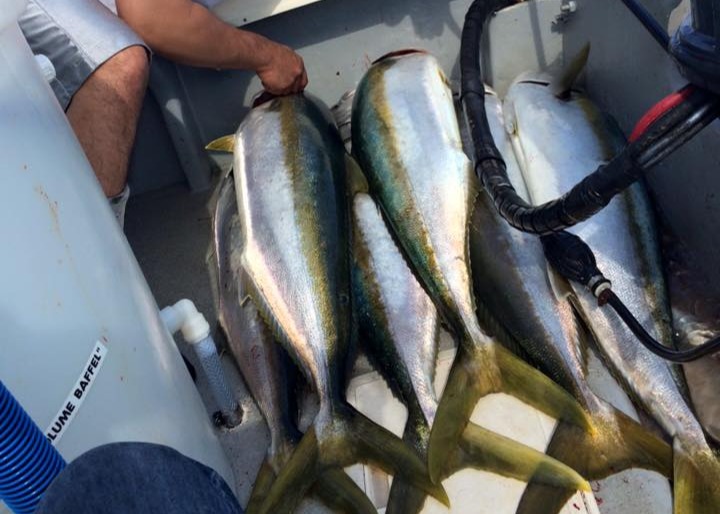
Surface iron fishing is one of the most exciting and uniquely Southern California techniques in all of saltwater fishing. There’s nothing quite like watching a boil of yellowtail or bluefin erupt on the surface, whipping a heavy chrome jig into the chaos, and feeling a fish hammer it on the retrieve. It’s raw, visual, and demands skill — which is why it’s become a badge of honor among SoCal anglers.
This guide covers everything you need to know: the right irons, how to cast them, retrieval techniques, gear setup, and when conditions are right for throwing iron.
What Is Surface Iron Fishing?
Surface iron refers to heavy metal jigs — typically 3 to 7 ounces of chrome, lead, or zinc — cast to breaking fish and retrieved rapidly across the surface. The iron skips, wobbles, and darts, imitating a panicked baitfish fleeing a school of predators. The visual nature of the strikes is what hooks anglers for life — fish explode on the iron at the surface in full view.
The technique originated in SoCal in the mid-20th century, and brands like Tady, Salas, and Jri are local legends. While jig fishing exists everywhere, the surface iron tradition — heavy jigs, fast retrieves, brutal strikes — is a distinctly Southern California thing.
Essential Surface Irons
You don’t need 50 different irons. A handful of proven models in the right sizes covers every situation. See our best yellowtail jigs guide and best tuna jigs guide for more detail on each model.
Tady 45 (4.5 oz): The all-around standard. Casts well, has a wide wobble, and catches everything. If you own one iron, own this one. Blue/white, scrambled egg, and mint are the essential colors.
Salas 7X (3 oz): The finesse option. Lighter weight matches smaller bait profiles. Great when fish are picky or the bait is small. Chrome and blue/white are reliable.
Tady A1 (6 oz): The distance iron. When you need to reach fish that are boiling far from the boat, the extra weight gets it there. Also produces a deeper, wider action that big fish prefer. Doubles as a tuna iron.
Salas 6X (4 oz): A narrower profile than the Tady 45, the 6X has a tighter, faster wobble. Excellent when fish want a slimmer bait profile. Many anglers keep both the 45 and 6X and switch between them until the fish tell them which one they want.
Tady 9 (3.5 oz): A compact, heavy-for-its-size jig that sinks fast and casts like a bullet. Great for wind and when you need to get the iron down quickly before retrieving on the surface.
Hooks: Replace the factory trebles on every iron you buy with Owner ST-66 trebles in 2/0–3/0. Factory hooks are made from soft wire that straightens on yellowtail and tuna. The ST-66 is 4X strong — it’s the single most important upgrade you can make. See our hooks by species guide for the right treble size for each iron.
Gear Setup for Surface Iron
Iron fishing demands specific gear. A spinning reel is preferred for casting distance — the open spool design lets you launch irons much farther than a conventional reel, which matters when fish are boiling 80+ yards away.
Reel: Spinning reel in the 6000–10000 size class with a fast retrieve ratio (6.0:1 or higher). You need to burn the iron back fast, and a high-speed reel does the work. The reel also needs a strong, smooth drag — yellowtail will smoke you in the kelp if your drag hesitates. See our yellowtail reel guide and bluefin reel guide for specific models.
Rod: 7–8 foot medium-heavy to heavy power with a fast action. You need the backbone to launch heavy irons and the stiffness to work them aggressively on the retrieve. A soft rod kills the iron’s action. A good iron rod has a moderate butt section for leverage and a fast tip for working the jig. See our 7-foot and 8-foot rod guides for specific models.
Line: 40–65lb braided line. Braid’s thin diameter maximizes casting distance, and the zero stretch transmits every jig movement and every bite directly. No leader needed for most iron fishing — the speed of the retrieve and the flash of the iron means fish commit before they can inspect the connection. Some anglers add a short (3-foot) 40lb fluorocarbon leader for extra-clear water or line-shy bluefin. See our fishing line guide for specific braid recommendations and our knots guide for the FG knot connection.
For complete rod and reel pairing advice, see our best rod and reel combo guide.
How to Cast Surface Iron
Casting a 4.5-ounce jig is different from casting a lure. The weight is substantial, and a bad cast can be dangerous to everyone on the boat.
The overhead cast: Point the rod at the fish, open the bail, and load the rod behind you with a smooth, controlled backswing. Drive forward with your body and arms together — the power comes from your hips and core, not just your arms. Release the line at about 45 degrees above the horizon. The jig should fly in a tight arc, not wobble or helicopter. If it helicopters, you’re not loading the rod smoothly enough.
The sidearm cast: Used when the wind is at your back or when you need a low trajectory to reach fish just beyond casting range. Same mechanics but on a horizontal plane. Keep the rod tip low and the arc tight.
The lob: For shorter distances, a simple underhand lob gets the iron out without the drama of a full cast. Useful when fish pop up close to the boat unexpectedly.
Safety: Always look behind you before casting. A 4.5-ounce chunk of metal traveling at high speed will seriously injure anyone in its path. Call out “casting!” so people around you know to duck. Keep your swing controlled — wild, uncontrolled casts are dangerous and inaccurate.
Retrieval Techniques
The speed burn: The most common surface iron retrieve. Crank the reel as fast as you can, keeping the rod tip low and the iron skipping on or just below the surface. The speed triggers a reaction strike from competitive fish. This is exhausting — your forearm will burn after a few casts — but it’s what catches fish in a frenzy.
The yo-yo burn: Retrieve fast, but periodically drop the rod tip and let the iron sink 5–10 feet before burning it back to the surface. This mimics a baitfish trying to dive for safety and then being forced back up. The change of direction often triggers a strike from following fish that won’t commit to a straight retrieve.
The slow roll: A moderate-speed retrieve that keeps the iron wobbling just below the surface. Used when fish are boiling lazily or when the bite is slow. Less dramatic but can be more effective when fish aren’t in full attack mode.
The dead stick: Cast the iron past the boil, let it sink to the depth you think the fish are at, and then begin a medium-speed retrieve. Effective when fish are feeding subsurface and not breaking the top. Watch for subtle taps.
When to Throw Iron
Surface iron is at its best when fish are actively feeding on the surface. Look for these signs: boiling water (fish crashing bait on the surface), birds diving and circling, bait balls getting pushed to the surface, and meter marks showing fish high in the water column.
In SoCal, the best iron fishing happens from late spring through fall when yellowtail and bluefin tuna push into the warm water that moves in. The Coronado Islands, La Jolla kelp, Catalina, and San Clemente Island are legendary iron grounds. Check the SST chart for warm water edges where bait concentrates and predators follow.
Surface Iron vs Other Techniques
| Situation | Best Approach |
|---|---|
| Fish actively boiling on surface | Surface iron (speed burn) |
| Fish showing but not committing | Switch to lighter iron or poppers |
| Fish deep on structure | Yo-yo jig or flat-fall |
| No surface activity, fish on meter | Live bait (fly-line or slider) |
| Wind killing your cast distance | Heavy iron (Tady A1) or switch to bait |
For a complete comparison of all the artificial techniques, see our jigs vs irons vs poppers guide.
When iron isn’t working: If fish are boiling but refusing iron, try poppers — the surface commotion triggers a different response than the flash-and-speed of iron, and fish that have been seeing the same Tady 45 from every angler on the boat will sometimes eat a popper without hesitation. See our dorado lures guide and tuna lures guide for other casting options including swimbaits and spoons.
Plan Your Trip
The best iron bite requires warm water, bait, and active fish. Check conditions:
- SST Chart — Find the warm water and temperature breaks
- Chlorophyll Map — Locate the bait that draws fish up
- Marine Weather — Wind kills iron fishing; check before you go
- Fleet Tracker — See where boats are finding surface activity
- AI Fishing Predictions — Data-driven forecasts for SoCal
- SD Fishing Season Calendar — Peak iron months
Related Guides
- Best Yellowtail Jigs & Irons
- Best Tuna Jigs
- Jigs vs Irons vs Poppers
- Best Poppers for Tuna
- Best Lures for Dorado
- Best Lures for Tuna
- Best Hooks by Species
- Best Reel for Yellowtail
- Best Reel for Bluefin Tuna
- Best 7-Foot Offshore Rods
- Best 8-Foot Offshore Rods
- Best Rod & Reel Combos for SoCal
- Best Fishing Line by Pound Test
- Braid vs Mono vs Fluorocarbon
- Best Fishing Knots
- Fly-Line Rig for Tuna
- Slider Rig for Live Bait
- Best Water Temp for Bluefin
- Best Water Temp for Yellowtail
- Best Water Temp for Dorado
- Overnight Trip Packing List
Tight lines!