The Carolina rig is one of the most effective bottom-fishing rigs for Southern California saltwater. It keeps your bait pinned to the bottom where halibut, corbina, and croaker feed, while giving the bait just enough freedom to look natural. If you surf fish or target halibut from a boat, you need this rig in your playbook.
Setting up a Carolina rig is straightforward, but the details matter — the wrong weight, hook, or leader length can mean the difference between limits and getting skunked. Here’s exactly how to tie one and when to use it.
What Is a Carolina Rig?
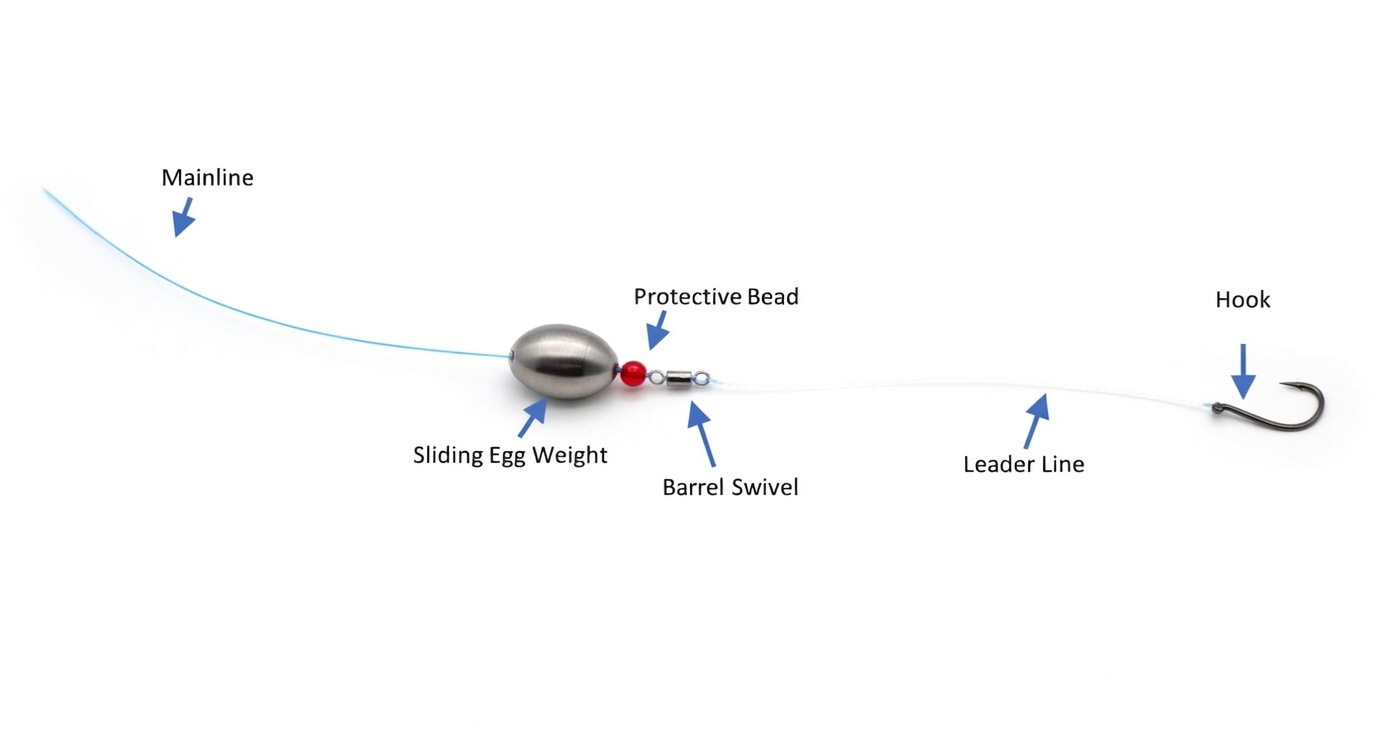
A Carolina rig separates your weight from your bait using a leader. The weight sits on the main line above a swivel, and the bait hangs below on a separate length of leader. This design lets the weight anchor to the bottom while the bait floats or drifts naturally in the current — exactly how a real baitfish or sand crab moves.
Compare this to a dropper loop rig where the weight hangs below and the bait sits higher in the water column. The Carolina rig excels when fish are feeding right on the bottom — which is most of the time for halibut, corbina, and California croaker.
How to Tie a Carolina Rig (Step by Step)
What you need: An egg sinker (1–4 oz depending on current and surf), a plastic bead, a barrel swivel (size 3–5), fluorocarbon leader line (15–20lb), and a hook (circle or kahle style, size 1/0–4/0).
Step 1: Slide the egg sinker onto your main line. The line passes through the hole in the center of the sinker, allowing it to slide freely.
Step 2: Slide a small plastic bead onto the main line after the sinker. This bead protects your knot from being damaged by the sinker banging against it. Don’t skip this step — without the bead, your knot will fail at the worst possible moment.
Step 3: Tie your main line to one end of the barrel swivel using a Palomar knot or improved clinch knot. The swivel acts as a stopper — the sinker and bead sit above it on the main line, free to slide. See our knot guide for step-by-step tying instructions.
Step 4: Cut a length of fluorocarbon leader — typically 18 to 36 inches. Tie one end to the other eye of the barrel swivel.
Step 5: Tie your hook to the free end of the leader. A Palomar knot works perfectly here.
That’s it. Bait the hook, cast it out, and let the sinker pull everything to the bottom. The sinker sits on the sand, the leader extends out with the current, and your bait drifts naturally right in the strike zone.
Dialing in the Details
Sinker Weight
Use the lightest weight that holds bottom. In calm surf or from a boat in minimal current, 1–2 ounces is plenty. In moderate surf, go to 3 ounces. In heavy surf or strong current, 4 ounces or even a pyramid sinker (which grips the sand) keeps you in place. Too much weight kills the natural presentation. Too little and you’re rolling down the beach.
Leader Length
This is the most important variable. A longer leader gives the bait more freedom to move but makes casting harder and reduces sensitivity. A shorter leader keeps better contact but looks less natural.
For halibut in the surf, 24–36 inches is ideal — halibut are ambush predators and won’t chase a bait far, but they do like it to look natural. For corbina, 18–24 inches works better because they pick up baits delicately and a shorter leader means you feel the bite sooner. From a boat targeting halibut in bays or along the coast, 18–24 inches keeps good control.
Hook Selection
Circle hooks in 2/0–4/0 are the best all-around choice for Carolina rigs. They hook in the corner of the mouth almost every time, which means better hookup rates and easier releases. When a halibut picks up your bait, just reel tight and the circle hook does the work — no big hookset needed. The Owner Mutu Light Circle (5114) in 2/0–3/0 is ideal for halibut Carolina rigs — light wire for better penetration on a soft-mouthed fish. For a complete breakdown of hook models and sizes, see our hooks by species guide.
Line and Leader
Main line should be braided line in the 15–30lb range. Braid’s sensitivity lets you feel the slightest bump — critical for detecting halibut bites, which are often just a subtle “tick.” The fluorocarbon leader (15–20lb) provides abrasion resistance against sand and rocks plus near-invisibility in clear SoCal water. The swivel prevents the braid from twisting as the sinker slides. Connect your braid to the swivel with a Palomar knot, and for braid-to-leader connections elsewhere in your setup, see our complete knot guide.
Best Baits for a Carolina Rig
The beauty of the Carolina rig is that it works with almost any bait. For halibut, live or frozen sardines, smelt, and squid strips are all productive. Cut squid is especially effective because it stays on the hook well and halibut love it. For corbina and perch in the surf, sand crabs (soft-shell when possible), bloodworms, and mussels are the top producers. Swimbaits and grubs also work on a Carolina rig — thread a 3–4 inch soft plastic on a jig head or weedless hook and fish it exactly the same way.
When and Where to Use It
The Carolina rig shines in these SoCal situations: surf fishing sandy beaches for halibut, corbina, and perch — particularly in the troughs between sandbars. Bay fishing from shore or kayak for halibut and spotted bay bass. Slow drifts along sandy bottom from a boat. And fishing structure edges where halibut stage to ambush bait moving along the sand-to-rock transition.
Check the SST chart before heading out — halibut start feeding aggressively when nearshore water hits the upper 50s to low 60s. Read our halibut temperature guide for seasonal patterns. For beach-specific advice, our Doheny surf fishing guide and halibut surf fishing guide walk you through reading the sand and finding productive troughs.
Tackle Setup
The right rod and reel make a big difference on Carolina rigs — you need sensitivity to feel light bites and enough backbone to cast weighted rigs:
Surf: A 9–11 foot surf rod paired with a 4000–5000 spinning reel. The longer rod gives you casting distance to reach the sandbars, and the spinning reel handles the lighter weights well.
Boat: A 7-foot medium rod paired with a 20lb class reel — either spinning or conventional. Shorter rod for working the rig vertically on a drift.
Line: 15–20lb braid with 15–20lb fluorocarbon leader. See our line guide for specific brand recommendations.
For complete rod and reel pairing advice, see our best rod and reel combo guide.
Plan Your Trip
Check conditions before you head out:
- SST Chart — Find the 59–65°F water where halibut feed
- Chlorophyll Map — Where bait is stacking nearshore
- Marine Weather — Surf, wind, and swell conditions
- Fleet Tracker — See where boats are working
- AI Fishing Predictions — Data-driven forecasts for SoCal
- SD Fishing Season Calendar — What’s biting this month
Related Guides
- Best Water Temp for Halibut
- How to Find Halibut Surf Fishing in SoCal
- Surf Fishing at Doheny State Beach
- Best Swimbaits for Halibut
- Dropper Loop Rig
- Best Hooks by Species
- Circle Hooks vs J Hooks
- Braid vs Mono vs Fluorocarbon
- Best Fishing Line by Pound Test
- Best Fishing Knots
- How to Tie a Palomar Knot
- Best Surf Casting Rods
- Best Surf Fishing Reels
- Best 20lb Reels
- Best Rod & Reel Combos for SoCal
- Spinning vs Conventional Reels
- Best 7-Foot Offshore Rods
- Fly-Line Rig for Tuna
- Slider Rig for Live Bait
- SD Fishing Season Calendar
Tight lines!