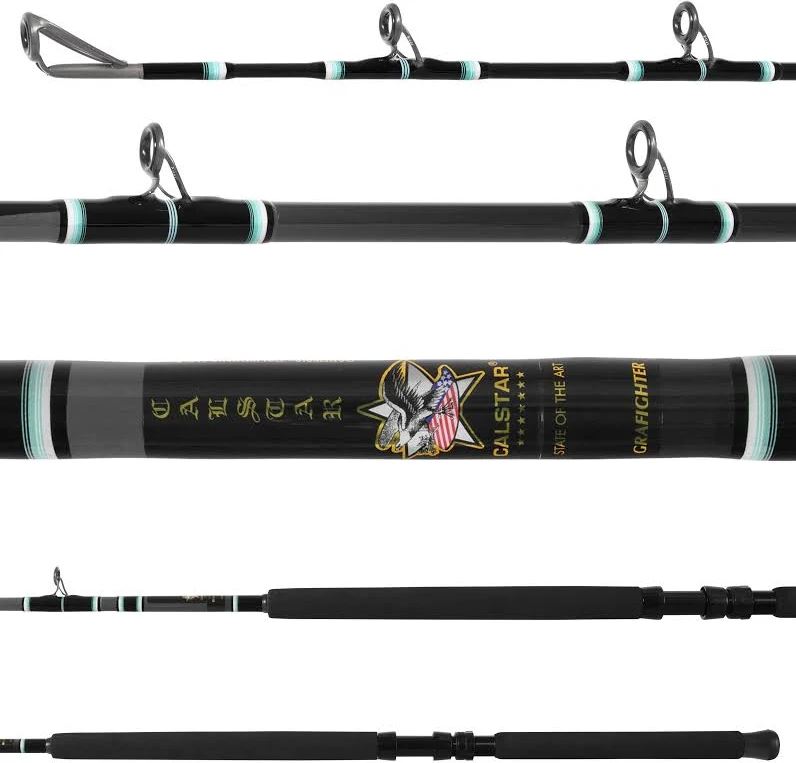
Choosing between graphite and fiberglass comes down to one fundamental trade-off: sensitivity vs. power. Graphite rods are lighter and more sensitive — you feel every tick and tap. Fiberglass rods are tougher and more forgiving — they absorb shock and fight big fish without breaking.
For SoCal saltwater fishing, the answer isn’t one or the other. It depends on what you’re targeting, where you’re fishing, and how you like to fight fish. Let’s break it down.
Quick Comparison
| Factor | Graphite | Fiberglass | Composite (blend) |
|---|---|---|---|
| Weight | Light | Heavy | Medium |
| Sensitivity | Excellent | Low | Good |
| Durability | Moderate — can snap under shock | Excellent — very hard to break | Good |
| Power (lifting) | Good | Excellent | Very good |
| Flex pattern | Fast action (tip flex) | Slow/moderate (full flex) | Moderate-fast |
| Price range | $80–$500 | $50–$300 | $100–$400 |
| Best for | Finesse, jigging, bite detection | Trolling, big game, live bait soaking | All-around use |
Graphite Rods: When Sensitivity Matters
Graphite (also called carbon fiber) rods transmit vibrations from the tip to your hand better than any other material. This means you feel subtle bites, bottom structure changes, and lure action with crystal clarity.
Best applications for graphite:
Halibut fishing. Halibut have some of the subtlest bites in saltwater — often just a faint “tick” as they mouth the bait. A graphite rod lets you detect these takes and react before the fish drops it. This applies to both surf fishing and boat fishing with swimbaits or Carolina rigs.
Jigging for yellowtail and calico bass. Working jigs and irons requires feeling what the lure is doing at depth. Graphite rods give you the feedback to know if your jig is working properly and to detect strikes instantly.
Surf fishing. A graphite surf rod is lighter to hold all day, casts farther (the stiffness transfers more energy during the cast), and lets you feel bites through the heavy surf rod length.
Light tackle inshore. Calico bass, spotted bay bass, and other inshore species often require finesse presentations where sensitivity is critical. Graphite paired with a spinning reel is the standard setup.
Trade-off: Graphite is more brittle than fiberglass. A sharp impact — dropping the rod, high-sticking it against the rail, or a sudden shock load from a big fish — can snap a graphite rod. They also tend to have fast action, which means less shock absorption during the fight.
Fiberglass Rods: When Power Matters
Fiberglass rods flex deeper into the blank and absorb more shock. They’re nearly indestructible, they fight big fish without fatiguing the angler as much, and they’re more forgiving of mistakes.
Best applications for fiberglass:
Tuna fishing. When you’re hooked into a 50+ lb bluefin that’s going to run, stop, and run again for 30 minutes, a fiberglass rod absorbs those surges without transmitting every jolt into your arms. The deep flex acts as a shock absorber, protecting both the line and the angler.
Trolling. Fiberglass trolling rods handle the constant load of dragging lures at speed. They don’t fatigue the way graphite can under sustained stress, and their flexibility cushions the initial strike so you don’t pull the hook.
Live bait soaking. When you’re fishing a fly-line rig or slider rig with live bait for tuna or white seabass, you want a rod that lets the fish eat the bait without feeling resistance. Fiberglass rods with moderate action give the fish time to commit before you set the hook.
Kids and beginners. Fiberglass rods are much harder to break. If you’re rigging up for your kid’s first fishing trip or handing a rod to someone inexperienced, fiberglass can take the abuse of being dropped, high-sticked, and mishandled without snapping.
Heavy bottom fishing. Cranking up rockfish, lingcod, or sheephead from deep water puts sustained load on the rod. Fiberglass handles this punishment better and has the backbone to lift heavy fish off the bottom.
Trade-off: Fiberglass rods are heavier and less sensitive. You’ll fatigue faster casting them all day, and you’ll miss subtle bites that a graphite rod would telegraph to your hand.
Composite (Blend) Rods: The Best of Both?
Many modern fishing rods use a blend of graphite and fiberglass — called composite blanks. These attempt to split the difference: more sensitivity than pure fiberglass, more durability than pure graphite.
Composite rods are a smart choice when you need one rod to cover multiple applications. A composite 7-foot offshore rod can handle jigging (where you want graphite sensitivity) and then transition to fighting a big yellowtail (where you want fiberglass forgiveness). They’re the most versatile option for SoCal party boat fishing.
Most mid-range rods in the $150–$300 range are composite, even if they’re marketed as “graphite.” Check the specs — if it lists an IM6 or IM7 graphite rating with “glass reinforcement,” it’s a composite.
Best Rod Material by Application
| Application | Best Material | Why |
|---|---|---|
| Surf casting | Graphite | Lighter weight, better casting distance, bite sensitivity |
| Halibut (boat) | Graphite | Detect subtle bites, sensitivity to bottom structure |
| Calico bass (jigging) | Graphite | Feel the jig, detect bites, fast hooksets |
| Yellowtail (party boat) | Composite | Sensitivity for jigging + power for the fight |
| Yellowtail (iron) | Graphite | Casting distance, retrieve feel |
| Bluefin tuna | Fiberglass or composite | Shock absorption, sustained load handling |
| Trolling | Fiberglass | Handles constant load, cushions strikes |
| Live bait (tuna/WSB) | Fiberglass | Lets fish eat without feeling resistance |
| Rockfish (deep drop) | Fiberglass | Lifting power from deep water |
| All-around party boat | Composite | Best versatility for mixed-species trips |
Understanding Rod Action
Rod material directly affects action — where the rod bends under load:
Fast action (mostly graphite): Only the top third of the rod flexes. Great for sensitivity, quick hooksets, and casting accuracy. The downside is less shock absorption — a big fish can break you off if you don’t manage your drag carefully.
Moderate action (composite): The top half of the rod flexes. Good balance of sensitivity and forgiveness. This is the most versatile action for SoCal fishing.
Slow action (mostly fiberglass): The rod bends all the way into the butt section. Maximum shock absorption and fish-fighting leverage, but less sensitivity and slower hooksets.
For most SoCal applications, moderate-fast action is the sweet spot. You get enough sensitivity to detect bites and enough flex to absorb surges from big fish.
What the Rod Ratings Mean
Graphite rods are often rated by their modulus — the stiffness measurement of the graphite fiber:
IM6 (intermediate modulus): More durable, slightly heavier. Good for budget-friendly rods that still perform well. Fine for most applications.
IM7–IM8: Better sensitivity-to-weight ratio. This is the sweet spot for quality fishing rods. Most rods in the $150–$300 range use IM7 or IM8.
IM9–IM12 (high modulus): Lightest and most sensitive, but also the most brittle. These are premium rods ($300+) best suited for experienced anglers who know how to handle delicate equipment.
Higher modulus isn’t always better — it just means lighter and more sensitive at the cost of durability. For harsh saltwater environments where rods get banged around on the boat, IM7 or composite is often the smarter choice.
Building Your Rod Collection
Here’s a practical three-rod setup that covers most SoCal saltwater situations:
Rod 1 — Graphite surf/inshore: A 9–10 foot graphite surf rod paired with a 4000–5000 spinning reel. Use it for surf fishing, bay fishing, and light inshore work.
Rod 2 — Composite party boat: A 7-foot composite rod paired with a 20–30lb conventional reel. Your workhorse for day trips targeting calico, yellowtail, bonito, and small tuna.
Rod 3 — Fiberglass/composite tuna stick: An 8-foot heavy rod paired with a 40lb+ conventional reel. For overnight trips, bluefin tuna, big yellowtail, and any fish that’s going to push your tackle to its limits.
For complete setup recommendations with specific models, see our best rod and reel combo guide.
Plan Your Next Trip
- SST Charts — Know what species are in your zone
- Chlorophyll Maps — Find the bait
- Fleet Tracker — See what’s biting on the boats
- Marine Weather — Check conditions
- AI Fishing Predictions — Get personalized forecasts
Related Guides
- Best 7ft Offshore Rods
- Best 8ft Offshore Rods
- Best Surf Casting Rod
- Spinning vs Conventional Reels
- Best Rod & Reel Combos for SoCal
- Braid vs Mono vs Fluorocarbon
Tight lines!