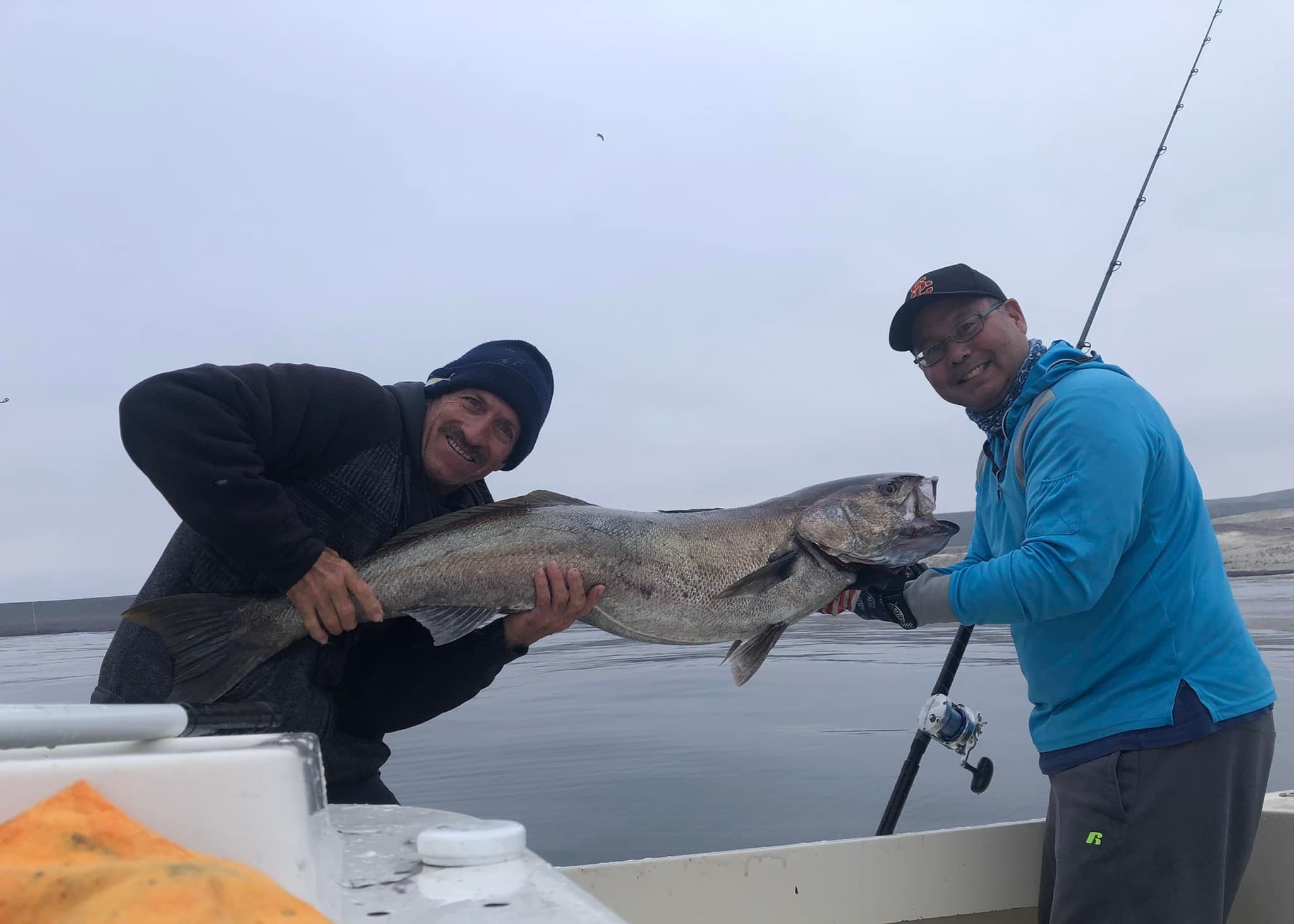
• Best Water Temperature for White Seabass Fishing

    Best Water Temperature for White Seabass Fishing

    White seabass are one of the most prized inshore catches in Southern California, and water temperature is the single biggest factor in finding them. Too cold and they’re deep and dormant. Too warm and they’ve pushed north or offshore. Hit the sweet spot and you’re in for world-class fishing.

    In this guide, we’ll cover the ideal water temperatures for white seabass, where they go as conditions change, and how to use SST charts to put yourself in the right spot at the right time.

    The Ideal Temperature Range

    White seabass are most active and aggressive in water between 58°F and 66°F (14–19°C). This is the range where they feed heavily, especially on squid — their favorite prey. Within that window, the magic number is around 60–64°F. That’s when the big spawning aggregations form and the fishing peaks.

    Below 56°F, white seabass slow down considerably. They don’t disappear, but they become much harder to target. Above 68°F, they tend to move deeper or northward to find cooler water.

    Seasonal Temperature Patterns in SoCal

    Winter (December–February): Water temps drop to 54–58°F along the coast. White seabass are still around but deeper and less active. Most catches come from boats working structure in 80–120 feet of water. Check the San Diego fishing season calendar for monthly breakdowns.

    Spring (March–May): This is prime time. As water warms through the upper 50s and into the low 60s, white seabass move inshore to spawn. The squid runs that come with spring upwelling draw massive schools into the kelp beds and along rocky coastline. March through May is the window most SoCal anglers wait for all year. A slider rig with live squid fished along kelp edges at dawn is the classic approach.

    Summer (June–August): Water hits 64–72°F. White seabass are still catchable but have spread out. Look for them in deeper kelp edges and around offshore structure where temps stay in the low-to-mid 60s. Temperature breaks become important — the fish hold on the cooler side. As the offshore water warms, this is when dorado and yellowfin start showing, so many anglers shift focus offshore.

    Fall (September–November): As water cools from the summer peak back through the 60s, a secondary feeding push happens. Not as concentrated as spring, but very productive for anglers who watch their SST charts and find pockets of 60–64°F water near kelp beds.

    How to Use SST Charts for White Seabass

    White seabass don’t roam the open ocean like tuna — they stick close to structure, kelp, and coastline. So when you check the SST chart, you’re looking for nearshore water in that 58–66°F range rather than offshore temperature breaks.

    Pay special attention to areas where slightly warmer water pushes against the coast. These spots concentrate bait, especially squid, and the seabass follow. The chlorophyll map is your best friend here — high chlorophyll near kelp beds in the right temperature range is almost a guarantee that bait (and seabass) are in the area. Read our guide on how to use chlorophyll maps for fishing for the full breakdown.

    The Squid Connection

    White seabass and squid are inseparable. When squid spawn — which they do in water between 57°F and 64°F, usually in spring — white seabass follow them in. If you see squid boats lit up at night on the fleet tracker, that’s a strong signal that white seabass are nearby.

    Squid egg beds in the kelp are magnets. White seabass will hang around these areas for weeks, gorging themselves. Fish near the kelp edges at dawn and dusk for the best results.

    White Seabass Gear and Lure Guides

    White seabass are powerful fish that can exceed 60 pounds, though most SoCal catches are in the 15–30 pound range. Here’s what you need and where to find our detailed guides:

    Rod and reel: A 7-foot medium-heavy rod paired with a 20–25lb class reel is ideal. A conventional reel gives you better drag control for big fish in the kelp. See our rod and reel combo guide for specific pairings.

    Line: 30–40lb braid with a 25–30lb fluorocarbon leader. The fluoro is critical — white seabass are line-shy in clear water, and they often feed around kelp where abrasion resistance matters. Connect braid to leader with an FG knot.

    Hooks: Circle hooks in 4/0–6/0 are the best choice for live bait — squid, sardines, and mackerel. The Owner Mutu Circle (5163) is the go-to for white seabass bait fishing. Circle hooks land in the jaw corner and reduce gut-hooking, which matters when you’re fishing in kelp and can’t afford a deep-hooked fish that dives into the canopy. See our hooks by species guide for the full breakdown.

    Rigs: A slider rig with live squid or sardine is one of the most effective white seabass techniques. For structure fishing, a dropper loop rig with cut squid or whole squid also produces.

    Lures: Swimbaits in 5–7 inch sizes work when white seabass are feeding on baitfish rather than squid. Slow-rolled through the kelp at dawn, they produce strikes from fish that won’t eat bait under a float. Flat-fall jigs fished vertically also catch seabass holding on deep structure.

    White Seabass Temperature Quick Reference

    ConditionTemp RangeWhat to Expect
    Too coldBelow 56°FDeep, inactive, hard to find
    Warming up56–58°FStarting to move inshore, scattered
    Prime zone58–66°FPeak activity, spawning, aggressive feeding
    Sweet spot60–64°FBest of the best — big schools, squid runs
    Too warmAbove 68°FFish go deeper or push north

    Plan Your Trip

    Check today’s conditions before you head out:

    Related Guides

    Tight lines!

  • White Sea Bass Surf fishing

    This video came up in my feed, had to share it.

    This is why we spend stupid amounts of hours standing in cold water.

    Watch this angler hook into a tank white sea bass while surf fishing Carbon Beach in Malibu. The fight is legit — those runs will get your heart going, almost spooled. After a solid battle in the wash, he lands a 39.5″ fish, well over the 28″ minimum. That’s a lot of meat for a surf session.

    White sea bass from the surf don’t come easy. You need the right conditions, the right timing, and a little luck. When it all lines up, this is what can happen. Here’s everything you need to know to put yourself in position for a fish like that.

    Why White Sea Bass Are a Surf Fishing Trophy

    White sea bass (Atractoscion nobilis) are the largest member of the croaker family on the West Coast, growing to over 90 lbs with a California minimum size of 28 inches. From the surf, fish in the 30–50 lb class are realistic targets during a good season — and unlike offshore pelagics that require a boat, white sea bass regularly feed close enough to shore to reach with a well-placed cast.

    They’re also notoriously difficult. WSB are spooky, have excellent hearing (they literally grunt and vibrate structures to communicate, which means they also detect vibration well), and feed in low-light conditions when the surf is manageable. Landing one from the sand is a legitimate achievement. That 39.5″ fish in the video represents years of experience, perfect timing, and being in the right place.

    When to Target White Sea Bass from the Surf

    The surf WSB bite runs March through July, with April, May, and June being the peak months. The trigger is the squid spawn. Pacific market squid come inshore to spawn on rocky bottom and kelp in late winter through spring, and white sea bass follow them in from deeper water. When squid are spawning in your area, WSB are close — sometimes very close to the beach.

    Check the water temperature before planning a trip. White sea bass are most active in 58–65°F water. The SST chart will show you when that temperature band has settled into your target stretch of coastline. Once the water warms past 68°F in summer, WSB move deeper and the surf bite fades.

    Best times of day: First light through mid-morning is the most productive window. The hour before and after sunrise is prime — low light, calmer surf, and actively feeding fish. Evening tides also produce, especially in summer when daytime water temps push fish deeper and they return to the shallows to feed after the sun drops. Midday during summer is largely a waste of time.

    Tide and surf: A moderate incoming tide with 2–4 foot surf is the ideal setup. Incoming water pushes baitfish and squid toward shore and activates WSB feeding. Flat-calm conditions can be productive early in the season when water is cooler. Big surf (6+ feet) makes fishing difficult and moves fish off the inshore structure they feed on.

    Where to Find White Sea Bass from the Surf

    WSB aren’t random along the beach. They follow structure and bait, and specific spots consistently produce year after year.

    Rocky points with kelp access: The ideal surf WSB location is a rocky headland or point where kelp grows close to shore. This is exactly what Carbon Beach at Malibu provides — rocky structure within casting range where squid spawn and WSB patrol. The kelp edge is the feeding lane; casting into or alongside the kelp is the move.

    Top SoCal surf WSB areas:

    • Malibu coast (Carbon Beach, El Matador, El Pescador, La Piedra) — rocky points with kelp, consistent spring producers
    • Leo Carrillo State Beach — rocky structure on both ends of the beach, a well-known WSB spot
    • Rincon Point (Ventura/Santa Barbara border) — the rocky point has produced big WSB during squid spawn years
    • La Jolla Cove area — kelp-adjacent surf zones with consistent spring populations
    • Point Loma kelp edge — accessible sections near the kelp produce during high tides
    • Channel Islands Harbor mouth — winter/spring WSB stage near the harbor entrance

    The common thread is proximity to kelp or rocky bottom. Sandy beach with no structure rarely holds WSB — they need something to ambush from.

    Bait and Lures for Surf White Sea Bass

    Fresh Squid — The #1 Bait

    During the squid spawn, nothing beats fresh squid. Hook a whole squid through the mantle on a circle hook in 3/0–5/0 and cast it to the kelp edge. The scent and natural profile are exactly what WSB are hunting. Fresh is critical — frozen works but fresh is significantly better. If local bait receivers have live or fresh squid available, that’s your bait.

    Live Mackerel and Sardines

    When squid isn’t available, live mackerel is the top alternative. Hook them through the nose or back on a 4/0–6/0 hook and let them swim toward structure. Sardines work the same way but are harder to keep alive through a surf cast. Both produce best on an incoming tide when bait is pushed toward shore.

    Swimbaits

    A 5–7 inch paddle tail swimbait on a 1–2 oz jig head is the top artificial for surf WSB. White, sardine, and squid patterns all work. Cast parallel to a kelp edge and retrieve slowly — slower than you think you need to. WSB eat a swimbait on a near-dead drift more often than on an active retrieve. The same swimbaits that catch halibut work here. Soft plastics also have the advantage of casting farther than fresh bait, which matters when the WSB are holding at the outer edge of the kelp.

    Bucktail Jigs

    A 2–4 oz white or chartreuse bucktail jig worked slowly along the bottom near rocky structure is an underrated WSB lure. It imitates a wounded fish and the slow bottom-bouncing presentation triggers strikes from fish that have ignored faster-moving lures. Effective when fish are visible on the sonar but not actively chasing bait.

    Gear for Surf White Sea Bass

    WSB pull hard and have soft mouths that tear easily — gear that’s too heavy loses sensitivity, gear that’s too light gets broken off on the first run into the kelp. The right balance is a medium-heavy setup with enough backbone to stop a fish from reaching the kelp, but light enough to feel the subtle pickup.

    Rod: A 10–11 foot medium-heavy surf rod or a 9-foot spinning rod rated for 20–30 lb line. The extra length of a surf rod helps cast past the break and keeps line off the water during the fight. A surf casting rod in the 10-foot range is ideal for WSB from the beach.

    Reel: A quality spinning reel in the 5000–8000 class — Shimano Saragosa or Daiwa BG in that size range. You need enough line capacity to handle the initial run (WSB make long, powerful first runs) and a smooth drag that won’t surge and pop the hook on a soft-mouthed fish.

    Line: 20–30 lb braid with a 25–30 lb fluorocarbon leader of 4–6 feet connected with an FG knot. Braid gives you casting distance and sensitivity; fluoro is invisible in clear inshore water where WSB can be line-shy. Don’t skip the fluoro leader — clear water and line-shy fish are the rule, not the exception.

    Hooks: Circle hooks in 3/0–5/0 for live bait and fresh squid. Circle hooks are the right choice here for two reasons: they dramatically reduce deep-hooking (WSB have a thin membrane around the jaw that tears easily on a gut-hooked fish), and the self-setting design means you don’t need to set the hook hard — just reel down and let the circle turn. See our circle vs J hook guide for the full breakdown.

    Technique: How to Fish the Surf for WSB

    Cast to structure, not open sand. If you’re casting into a flat sandy bottom with no kelp or rocks nearby, you’re not fishing where WSB live. Every cast should be aimed at a kelp edge, a rocky point, or a sandy pocket adjacent to structure. If you can see kelp on the surface, cast to the edge of it.

    Slow down. This is the most common mistake. WSB are not aggressive, fast-chasing predators like tuna or yellowtail. They’re ambush hunters that often pick up a bait slowly and move off with it. If you’re retrieving a swimbait at yellowtail speed, you’re fishing it wrong. Crawl it. Let it sink. Pause. WSB often eat on the pause or the initial sink.

    Set the drag lighter than you want to. The first run of a big WSB will feel like you’ve hooked a train. Their initial surge toward the kelp is where most fish are lost — either the hook tears out of the soft jaw tissue or the line gets wrapped in kelp and breaks. Set your drag so the reel gives line under hard pressure rather than locking up. You’ll get the fish back once it stops running; you won’t get it back if the hook tears out.

    Keep the rod tip up in the wash. The landing is the most dangerous part. WSB thrash violently in shallow water and the hook can pop free in the confusion. Keep steady pressure, let the surf help push the fish toward shore, and back up the beach as the wave recedes to slide the fish onto the sand. Don’t try to grab it prematurely — wait until it’s fully beached before reaching for it.

    Be quiet. No loud footsteps on rock, no gear clanging. White sea bass are skittish and will spook from vibration. This is especially true when fishing rocky points where sound travels through the substrate.

    Regulations

    Current California regulations for white seabass (confirm at CDFW before your trip as these can change):

    • Minimum size: 28 inches total length
    • Bag limit: 3 fish per day
    • Season: Open year-round in most zones
    • License: California sport fishing license required

    The 39.5″ fish in the video above is well above the minimum — that’s a quality fish by any measure. Most surf-caught WSB run 28–40 inches. Fish over 40 inches are uncommon from the surf and worth releasing if you’re not keeping it.

    Frequently Asked Questions

    What is the best time of year to surf fish for white sea bass?

    March through June is the peak window, driven by the squid spawn. April and May are typically the best months when squid are actively spawning on inshore rocky structure and WSB are feeding close to the beach. Check the SST chart for 58–65°F water — that temperature range correlates with the most active bite.

    What’s the best bait for white sea bass from the surf?

    Fresh squid during the squid spawn — nothing else is close. The rest of the year, live mackerel is the top bait. Artificially, a 5–7 inch white swimbait retrieved very slowly along a kelp edge is the most reliable option. See our swimbait guide for rigging details.

    Where do I find white sea bass from the beach?

    Rocky points with adjacent kelp are the key habitat — places like Carbon Beach and Leo Carrillo in Malibu, Rincon Point in Ventura, and kelp-adjacent surf zones around La Jolla. Sandy beach with no structure rarely holds WSB.

    What size rod do I need for surf WSB?

    A 10–11 foot medium-heavy surf rod is ideal. The length helps cast past the break and keep line off the water during the fight. Pair it with a 5000–8000 class spinning reel and 20–30 lb braid with a fluorocarbon leader. See our surf rod guide and surf reel guide for specific recommendations.

    What’s the minimum size for white sea bass in California?

    28 inches total length, with a bag limit of 3 fish per day. Always verify current regulations at CDFW before your trip. The fish in the video above at 39.5 inches is a quality keeper — most surf-caught WSB are in the 28–40 inch range.

    Why are white sea bass so hard to catch?

    They’re spooky, feed primarily in low light, and require specific conditions (squid spawn timing, right temperature, right structure) to be accessible from the surf. They also have subtle pickups — unlike a yellowtail that hammers a lure, WSB often just slowly engulf a bait and swim off. Slow presentations and light drag settings are the keys most anglers miss.

    Do white sea bass fight hard?

    Yes — especially on the first run. A big WSB will make a powerful initial surge toward structure that will test your drag and your nerves. The fight in the video above is a good example: that fish nearly spooled the angler before it was turned. Once they’re off the kelp and in open water they tire relatively quickly, but the first 30 seconds is chaos.

    Plan Your Trip

    Related Guides

    Tight lines.