The flasher is the single most impactful piece of ice fishing electronics. Drilling holes randomly across a lake and hoping for fish produces frustrating days. Drilling holes with a flasher in hand — seeing immediately whether fish are present, how deep they’re holding, and how they’re reacting to your jig — transforms ice fishing into a methodical hunting exercise. Experienced ice anglers consistently rank the flasher as the equipment with the highest impact on catch rates, after the auger that lets you make the hole in the first place.
This guide covers the three flasher brands that dominate the Upper Midwest ice fishing market — Vexilar, MarCum, and Humminbird — and the specific models that consistently perform. The flasher market is dominated by Vexilar, but MarCum has real strengths for some use cases, and Humminbird’s color screen alternative appeals to anglers who want a more modern display. Pair with the ice fishing guide for the broader gear context and the augers guide for the hole-drilling companion.
⚡ Quick Picks by Situation
Best overall: Vexilar FLX-28 Pro Pack II — the gold standard for ice fishing flashers.
Best alternative: MarCum LX-7L — Vexilar’s main competitor with strong features.
Best color screen: Humminbird ICE HELIX 7 — modern color display alternative.
Best for beginners: Vexilar FLX-28 — easiest to read, most documentation available.
Best for serious anglers: Vexilar FLX-28 or MarCum LX-7L based on personal preference.
What a Flasher Does
A flasher is a real-time sonar unit designed specifically for vertical ice fishing applications. Unlike scrolling fish finders that display history across the screen, flashers show a single moment in time — what’s directly below the transducer right now — on a circular dial or vertical bar display. The display updates many times per second, creating a real-time view of:
- The bottom of the lake — appears as a strong return at the depth where the sonar hits hard structure
- Your jig — shows as a thin mark in the water column, moving up and down as you jig
- Fish in your cone — additional marks at various depths, often changing color or thickness based on size and proximity
- Bait clouds — diffuse returns showing schools of small baitfish
- Vegetation — wispy returns near bottom showing weeds or grass
The skill develops over time but the basics come quickly: you learn to see your jig, watch fish come into view, see them approach the jig, and trigger strikes by jigging motion. This real-time feedback is what makes the flasher transformative compared to fishing blind.
Vexilar Flashers
Vexilar FLX-28 Pro Pack II
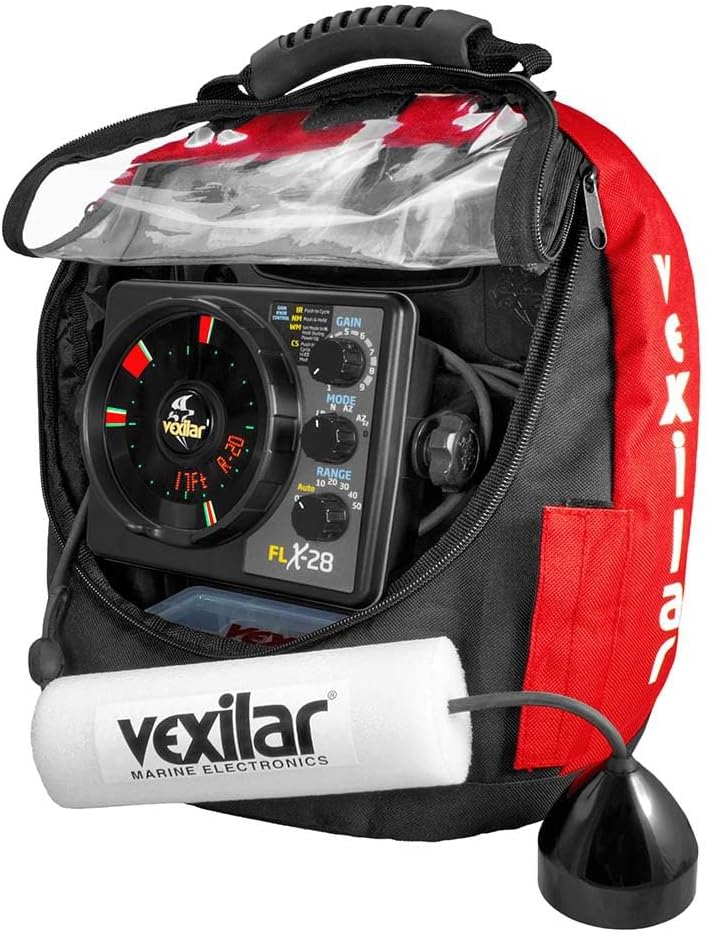
The Vexilar FLX-28 is the modern Vexilar flagship and the de facto gold standard of the ice fishing electronics category. Vexilar invented the modern ice fishing flasher format in the early 1980s and has held the market lead since. The FLX-28 represents the current high-end model with several refinements over previous generations: 525-foot maximum depth (more than enough for any Great Lakes ice fishing), 1500 watts of power (clean signal even in challenging conditions), multiple zoom modes (zoom into a specific 5-foot window for detailed presentation), and weather-resistant construction designed for sub-zero conditions. The Pro Pack II configuration includes the head unit, transducer, soft case, and battery — a complete out-of-box setup. Most Upper Midwest ice anglers settle on a Vexilar within their first one or two seasons. The Vexilar dealer network is dense across Minnesota and Wisconsin — replacement parts and repair are easy to source. Price point around $700-800 reflects the category benchmark; cheaper Vexilar models (FLX-20, FL-8) offer entry-points at lower cost while maintaining the brand reliability.
MarCum Flashers
MarCum LX-7L
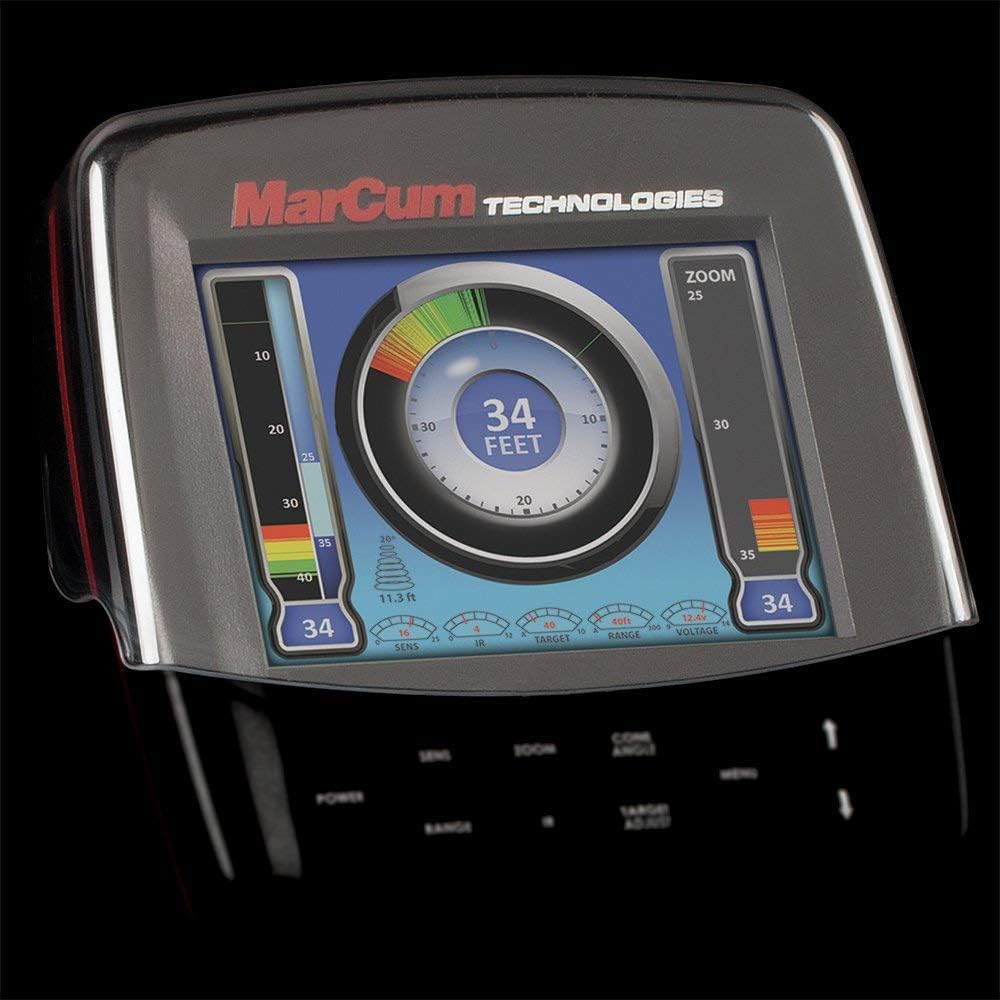
MarCum is Vexilar’s primary competitor and has been gaining market share over the past decade with features that some ice anglers prefer. The LX-7L combines a traditional flasher dial display with a digital LCD screen, providing both the real-time circular feedback that flasher anglers prefer and additional information (depth, temperature, battery, settings) on the screen. The dual-display approach is the MarCum advantage. Sonar performance is competitive with Vexilar; the difference is in the user interface preference. The LX-7L’s beam choices (8-degree narrow or 20-degree wide) give better flexibility than fixed-beam Vexilar models. Anglers who fish multiple species and varying conditions often prefer the MarCum’s adjustability. The dealer network is less dense than Vexilar’s but still adequate in major Upper Midwest markets. Best for anglers who want the modern features and don’t have brand loyalty to Vexilar.
Color Screen Alternatives
Humminbird ICE HELIX 7
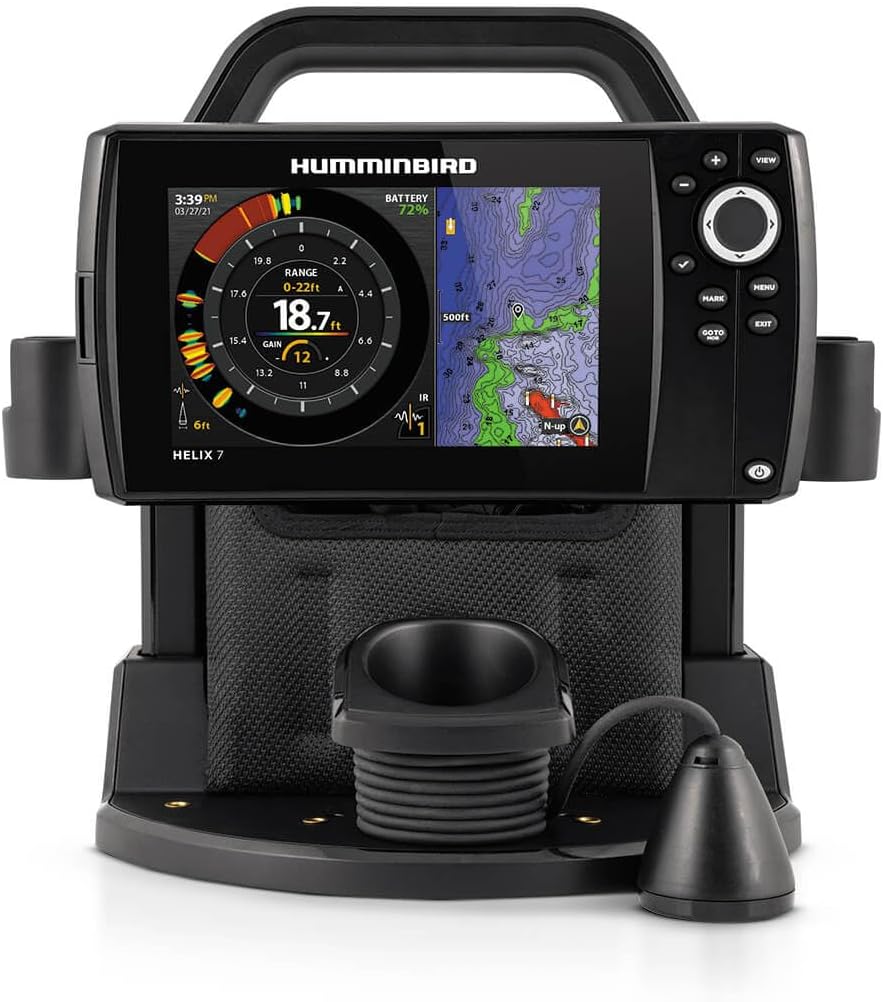
The Humminbird ICE HELIX 7 represents the modern alternative to traditional flasher displays. Instead of a circular dial, the HELIX uses a 7-inch color LCD screen that can display traditional sonar (scrolling history), CHIRP sonar (better target separation), DownScan (clear bottom imaging), and GPS mapping all in one unit. Some Upper Midwest ice anglers have moved entirely to color screen units; others find the traditional flasher dial more intuitive for real-time fish-watching. The HELIX wins for anglers who already use Humminbird units on their boat — same interface, transferable understanding. The unit also bridges open-water and ice fishing — the same head unit works as a boat fish finder in summer with appropriate transducer mounting. Price point around $500-700 depending on package. For anglers building a unified electronics ecosystem (boat + ice), the HELIX provides continuity that single-purpose flashers don’t.
How to Read a Flasher
The basic skill develops over a season:
1. Identify the bottom. The strongest, most consistent return — typically the thickest band on the dial. This tells you the water depth.
2. Identify your jig. Lower your jig to the bottom, then lift slightly. The mark that moves up and down with your rod motion is your jig.
3. Watch for fish marks. Additional marks appearing at various depths between your jig and bottom. Thicker marks indicate larger fish or fish closer to the transducer.
4. Read fish reactions. A fish that rises to look at your jig is interested. A fish that follows your jig up is committed. A fish that backs away from your jig has rejected it — change presentation.
5. Watch for “gibbing” — short marks that quickly appear and disappear. Often indicate fish moving through the sonar cone rather than holding in your area. A high-frequency gib pattern means active feeding fish in the area.
The transition from beginner to confident flasher user usually takes 5-10 fishing days. After that, reading the screen becomes second nature.
Cone Width and Beam Angles
The transducer’s beam width determines how much area the flasher “sees” below the ice. Wider beams cover more area but lose precision. Narrower beams give precise target separation but cover less.
| Beam Width | Best For | Trade-Off |
|---|---|---|
| 8°-10° (narrow) | Targeting individual fish at depth, vertical jigging | Misses fish off to the side; small effective area |
| 15°-20° (medium) | General-purpose ice fishing | Balanced coverage and precision |
| 25°-30° (wide) | Finding schools of fish, surveying area | Multiple fish in cone confuse interpretation |
Most Upper Midwest ice anglers use 15-20° beams for general fishing. Anglers targeting specific suspended fish (lake trout, deep walleye) sometimes switch to narrower beams. MarCum units offer beam choice between 8° and 20°; Vexilar units typically run fixed beam widths matched to their model.
Battery and Cold Weather Performance
Flashers run on lead-acid or lithium battery packs. Battery life and cold weather behavior matter:
Lead-acid batteries — traditional flasher power source. Heavy (4-7 lbs), but durable in cold and inexpensive to replace. Typical 12V 9Ah pack runs a flasher 8-15 hours per charge depending on screen brightness and ambient temperature.
Lithium battery packs — modern option, lighter (1-2 lbs), longer effective life. Vexilar, MarCum, and aftermarket suppliers all offer lithium replacements. Higher cost but the weight savings matter when carrying the flasher pack between holes.
Cold weather drain — both battery types perform worse in cold. Plan for 50-70% of rated battery life in 0°F conditions. Carry a backup or charge between sessions.
Battery charging — never charge a frozen battery. Bring it indoors first, let it warm to room temperature, then charge.
Mounting and Setup
How you position the transducer affects how the flasher works:
In-hole mounting. The transducer hangs into the fishing hole at a fixed depth (usually just below the ice). This is the standard setup — fast, simple, and provides the clearest signal.
Separate cone hole. Drill a second smaller hole next to your fishing hole and put the transducer there. This separates the transducer from line tangles and removes signal interference from your jig motion.
Transducer ice melt. Some anglers heat the ice slightly to ensure good acoustic coupling between transducer and water. Less critical with modern units but worth knowing about for marginal conditions.
Float setup. The transducer hangs from a foam float in the hole, keeping it at consistent depth and preventing it from tangling with line.
Modern Live Sonar Alternatives
The flasher category has been challenged in the past few years by “live sonar” units like Garmin LiveScope, Lowrance ActiveTarget, and Humminbird MEGA Live. These show a continuously scrolling 2D image of the water column with much more visual information than flashers. They’re more expensive ($1,500-3,000 for full setups) and have a steeper learning curve. Most Upper Midwest ice anglers continue to prefer traditional flashers for the simplicity and proven reliability. Live sonar is the technology to watch — it may eventually replace traditional flashers — but the flasher category remains the established standard.
Common Mistakes
Buying too cheap. Bargain flashers ($150-300 range) generally lack the signal processing of premium units. Marks are harder to read; fish are harder to distinguish from interference. The category benefit is in the high-end Vexilar / MarCum / Humminbird tier.
Skipping the user manual. Each flasher has unique features (zoom modes, sensitivity adjustments, interference reduction). Reading the manual once before your first trip pays back in fish caught.
Not learning to read marks. The flasher is only as useful as your ability to interpret what it shows. Spend a few hours practicing on familiar water before relying on it during a destination trip.
Wrong battery for the trip. Lead-acid batteries get heavy on long walking trips. Lithium batteries are worth the upgrade for anglers who travel light. Match battery to use.
Setting sensitivity too high or low. Sensitivity controls how much signal noise vs fish marks appear on screen. Too high produces noise; too low misses fish. Adjust to current conditions — every lake and depth requires slight tweaks.
Comparing brands without trying both. Vexilar and MarCum have distinct interfaces. Most ice anglers develop a preference and stick with it. Try a friend’s unit (or rent at a resort) before committing if possible.
Gear to Pair with Your Flasher
- Best Ice Augers — drill the holes the flasher fishes
- Best Ice Fishing Rods
- Best Ice Fishing Reels
- Best Ice Fishing Jigs — what you’ll watch on the screen
- Best Ice Shelters
- Ice Fishing Guide
- Ice Fishing Safety Guide
Frequently Asked Questions
What’s the best ice fishing flasher?
The Vexilar FLX-28 Pro Pack II is the gold standard. The MarCum LX-7L is the strongest alternative. The Humminbird ICE HELIX 7 appeals to anglers who want color screen displays.
Do I need a flasher to ice fish?
No, but you’ll catch significantly more fish with one. The flasher transforms ice fishing from “drop bait, hope for the best” to “actively hunt fish, present to them when they appear.” Most anglers consider it the most impactful single piece of equipment after the auger.
What’s the difference between Vexilar and MarCum?
Vexilar invented the modern flasher category and dominates market share. MarCum competes with newer features like dual flasher/digital displays and adjustable beam angles. Both work — the choice often comes down to brand loyalty and interface preference.
Color screen or traditional flasher dial?
Traditional flasher dial: faster real-time feedback, simpler to learn, proven reliability. Color screen (HELIX): more information, transferable to summer boat use, modern interface. Most experienced ice anglers prefer the traditional flasher for its real-time visualization advantages.
How long does flasher battery last?
Lead-acid: 8-15 hours in mild conditions. Lithium: 12-20+ hours. Both drop 30-50% in extreme cold (below 0°F). Carry a backup battery for serious trips, or charge between sessions.
Do I need a special transducer for ice fishing?
Ice fishing flashers come with transducers designed for vertical use. The transducer cable is typically 25 feet, long enough to hang into the deepest holes. The ice-specific cone angle is optimized for vertical presentation — don’t try to substitute a boat transducer.
Can I use a fish finder for ice fishing?
Yes — units like the Humminbird ICE HELIX 7 are specifically designed for ice use. Standard boat fish finders can be adapted with the right transducer mounting (a “ice-bird” or similar adapter), but dedicated ice units perform better and require less setup.
Plan Your Trip
- SST Charts
- Fleet Tracker
- Marine Weather
- AI Fishing Predictions
- Minnesota Fishing Season Calendar
- Wisconsin Fishing Season Calendar
- Upper Midwest Fishing Trips
Related Guides
- Ice Fishing Guide
- Ice Fishing Safety Guide
- Best Ice Augers
- Best Ice Fishing Rods
- Best Ice Fishing Reels
- Best Tip-Ups
- Best Ice Shelters
- Best Ice Fishing Jigs
- Best Ice Fishing Line
- Ice Fishing for Walleye
- Ice Fishing for Pike
- Ice Fishing for Crappie
- Ice Fishing for Perch
- Ice Fishing for Lake Trout
- Lake of the Woods Ice Fishing
- Mille Lacs Fishing Guide
- Upper Midwest Fishing Trips
Tight lines!
Affiliate Disclosure: As an Amazon Associate, fishing-reports.ai earns from qualifying purchases. Links to Amazon on this page are affiliate links — if you click and buy, we may earn a small commission at no extra cost to you.