Planer boards do something downriggers can’t: they take your lure away from the boat. While downriggers put your line directly below the boat at a specific depth, planer boards push the line 50 to 150 feet out to the side. This matters for two reasons. First, it dramatically widens your search lane — instead of dragging spoons through a 10-foot-wide zone behind the boat, you cover 200+ feet of water on each trolling pass. Second, fish that get spooked by the boat’s hull and prop wash don’t get a chance to spook your outside lines. Big browns and shallow-water kings in particular won’t strike a line running too close to the boat.
For spring Great Lakes salmon fishing, planer boards aren’t optional — they’re the primary technique. Coho and brown trout in 5–25 feet of water are essentially uncatchable without boards. Even in summer, boards expand your spread and add an extra dimension to a downrigger-focused setup. This guide covers what to buy and how to use them.
⚡ Quick Picks by Situation
Best inline planer board: Off Shore Tackle OR12 Side-Planer — the proven salmon and trout standard.
Best walleye board: Church Tackle TX-22 — most popular walleye-specific board, works for salmon too.
Heavy line / mag board: Off Shore Tackle OR16 Pro Mag — larger version for thick line and deeper applications.
Snap weight system: Snap Release Clips — for adding weight to planer board lines.
Best for beginners: Either OR12 or TX-22 — both are forgiving, easy to set up, and proven producers.
Inline vs Mast Planer Boards
Before picking a specific board, decide between two systems:
Inline planer boards attach directly to your fishing line. The line runs from your rod, through the planer board’s release clip, and out to the lure. When a fish hits, the line releases from the board and you fight the fish on the rod directly. The board floats freely until you reel it in. This is the easier setup for most anglers and the standard for Great Lakes salmon, walleye, and brown trout. The Off Shore Tackle OR12 and Church Tackle TX-22 are both inline boards.
Mast / cable planer boards use a large pair of boards connected to a mast on the bow of the boat by a heavy cable. Multiple fishing lines clip to the cable rather than to individual boards. This system covers more water and runs more lines simultaneously, but requires a substantial mast installation and a learning curve to operate. Charter boats often use mast systems; most recreational anglers don’t.
For 95% of recreational anglers, inline boards are the right choice. The rest of this guide focuses on inline setups.
Inline Planer Boards
Off Shore Tackle OR12 Side-Planer
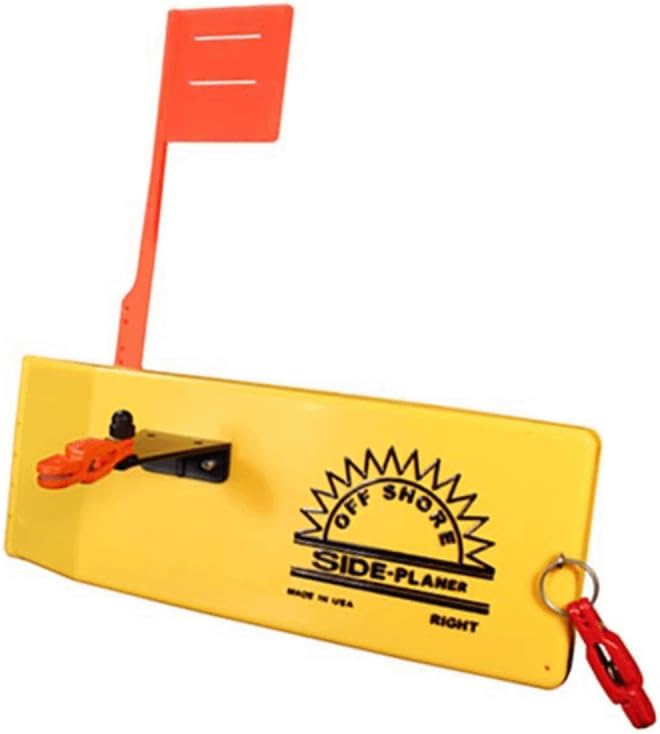
The Off Shore Tackle OR12 is the salmon and trout standard inline board across the Great Lakes. The design has been refined over decades — a foam-cored hull that tracks straight at trolling speeds, an adjustable release clip in the front, and an “OR-19 Snapper Releases” pin in the back that holds your line until a fish triggers it. The board planes 50–150 feet off the boat depending on how much line you let out, giving you wide coverage. The OR12 handles braid, mono, and lead core lines equally well. Available in red/orange and yellow color schemes for visibility against different water conditions. The release tension is adjustable on a dial — set it lighter for finesse coho strikes, heavier for kings that need to commit before pulling free. This is the board you’ll see on 80% of salmon-focused Great Lakes recreational boats.
Church Tackle TX-22 Walleye Planer Board
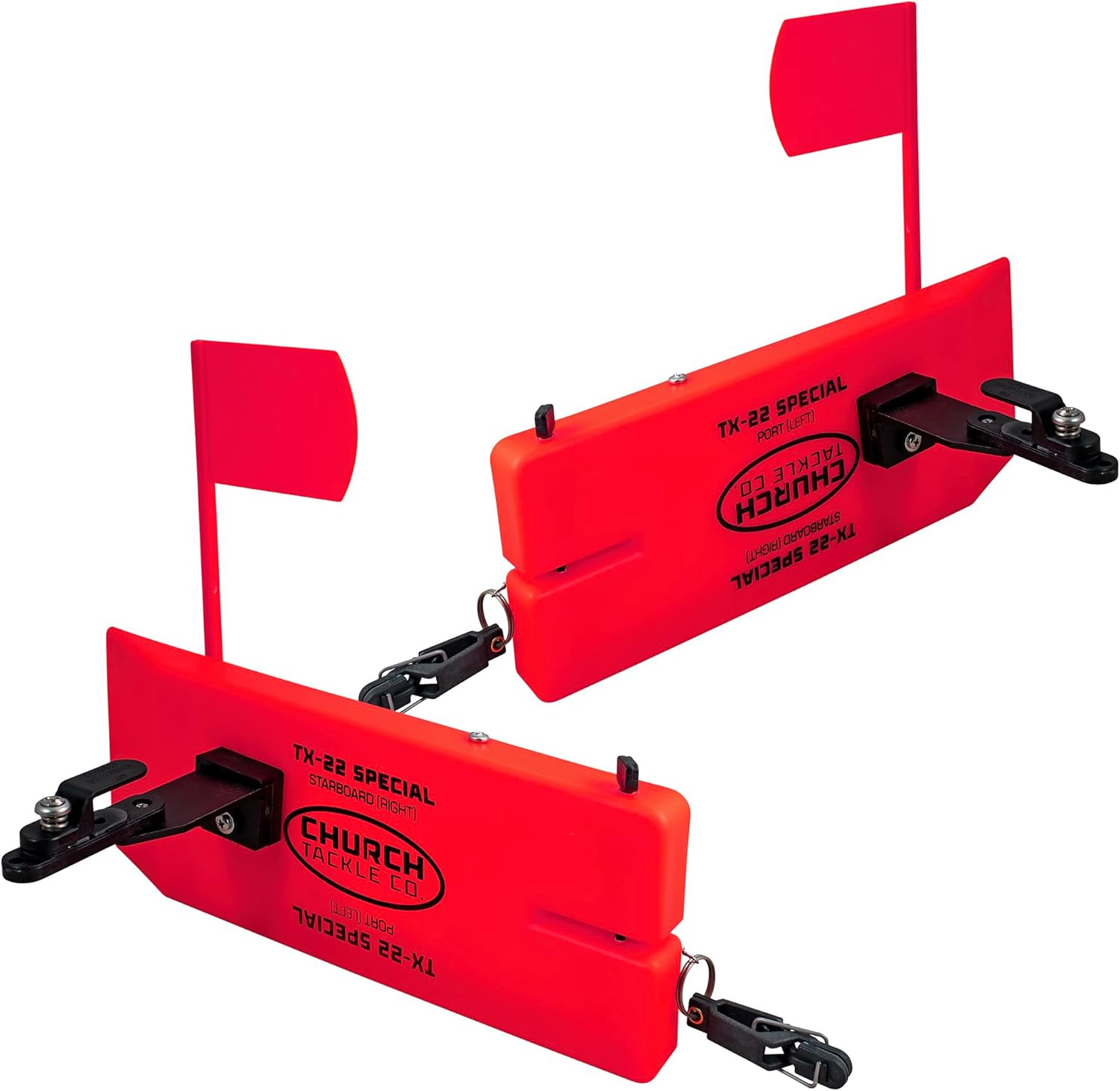
Church Tackle’s TX-22 is the walleye-focused alternative to the Off Shore OR12, and it crosses over to salmon use with no issues. The TX-22 has a slightly different release clip design — Church’s “Tattle Flag” system makes it easy to see when a small fish hits without immediately releasing the line. This matters more for walleye (which often strike lightly) than salmon (which usually hammer the lure), but the visual confirmation is useful in both fisheries. Construction quality is on par with Off Shore, and the boards plane stably at the same trolling speeds. Most anglers settle on one brand or the other based on which they tried first and got comfortable with; both produce identically. If you’re building a multi-species trolling setup that includes serious walleye work, the TX-22 is the slight edge. For salmon-only, either works.
Setting Up Planer Boards
A typical inline board setup runs three boards per side — close, mid, and outside. Six boards total on a serious recreational rig. The process:
- Set your lure depth first. Boards don’t control depth — they control horizontal position. For depth, use lead core, copper, or a snap weight before setting the board.
- Clip the line into the board’s release clip. Adjust tension based on your target — lighter for finesse fish, heavier for committed strikes.
- Set the board out. Let out 50–100 feet of line behind the boat at trolling speed, then attach the board and let it plane outward.
- Manage your spread. Outside board first, then mid, then inside. Avoid running boards in a straight line — stagger them so each is in different water.
- When a fish hits: The line releases from the board’s clip. The board floats free until you reel it in along with the fish.
Release Clip Tension
Getting the release tension right is the single most important skill in planer board fishing. Too loose, and the board releases every time you hit chop. Too tight, and the fish can’t pull the line free, killing your hookset.
| Target Species | Tension Setting | Why |
|---|---|---|
| Spring Coho (3–6 lbs) | Light | Smaller fish, light strikes, need easy release |
| Brown Trout (4–10 lbs) | Light to Medium | Variable strike intensity |
| Summer King Salmon (15–25 lbs) | Medium to Heavy | Hard strikes, fish need to commit fully |
| Walleye (3–8 lbs) | Light | Light strikes, finicky fish |
| Lake Trout (10–20 lbs) | Medium | Steady strikes, deliberate fight |
Using Planer Boards by Season
Spring (April–May): The Primary Tool
This is when boards do their best work. Coho and brown trout push into 5–25 feet of water. Downriggers aren’t useful in water that shallow. Boards with Husky Jerks, Rapalas, and small spoons in 5–25 feet of water produce excellent catches. Set the board, troll the depth contour, and wait for the release.
Summer (June–August): The Outside Lines
When kings and coho push deep, downriggers become primary and boards become secondary. But boards still produce by covering water outside the boat’s footprint. Run lead core or copper line off the boards to reach moderate depths (30–60 feet) without spooking fish with prop wash. The boards become the wing positions of your spread.
Fall (September–October): Returns to Primary
As surface temps drop and fish push shallow again, boards return to primary use. Pre-spawn kings staging near tributary mouths often hit boards in 30–50 feet of water more readily than downrigger spreads.
Common Mistakes
Wrong release tension. The #1 mistake. Tension that worked last season needs recalibration this season as the rubber clips age. Test before every trip with a similar-weight pull.
Boards too close to the boat. If your boards are only 30 feet out, you’re not using their full benefit. Outside boards should plane 100–150 feet from the boat.
Running boards in a straight line. If three boards are all on the same horizontal line behind the boat, they’re all in the same water. Stagger them so each is in different water depth or coverage.
Not adjusting for wind. Wind affects board planing significantly. With a strong crosswind, boards on one side plane wider than the other. Adjust line out lengths to compensate.
Forgetting to retrieve the board. When a fish releases the line, the board floats free. In rough water it can drift quickly. Mark its general location and retrieve it as soon as the fish is landed.
Using boards for depth control. Boards don’t control depth — only horizontal position. Pair with lead core, copper, or snap weights for depth control.
Accessories for Planer Boards
Snap Weight Release Clips
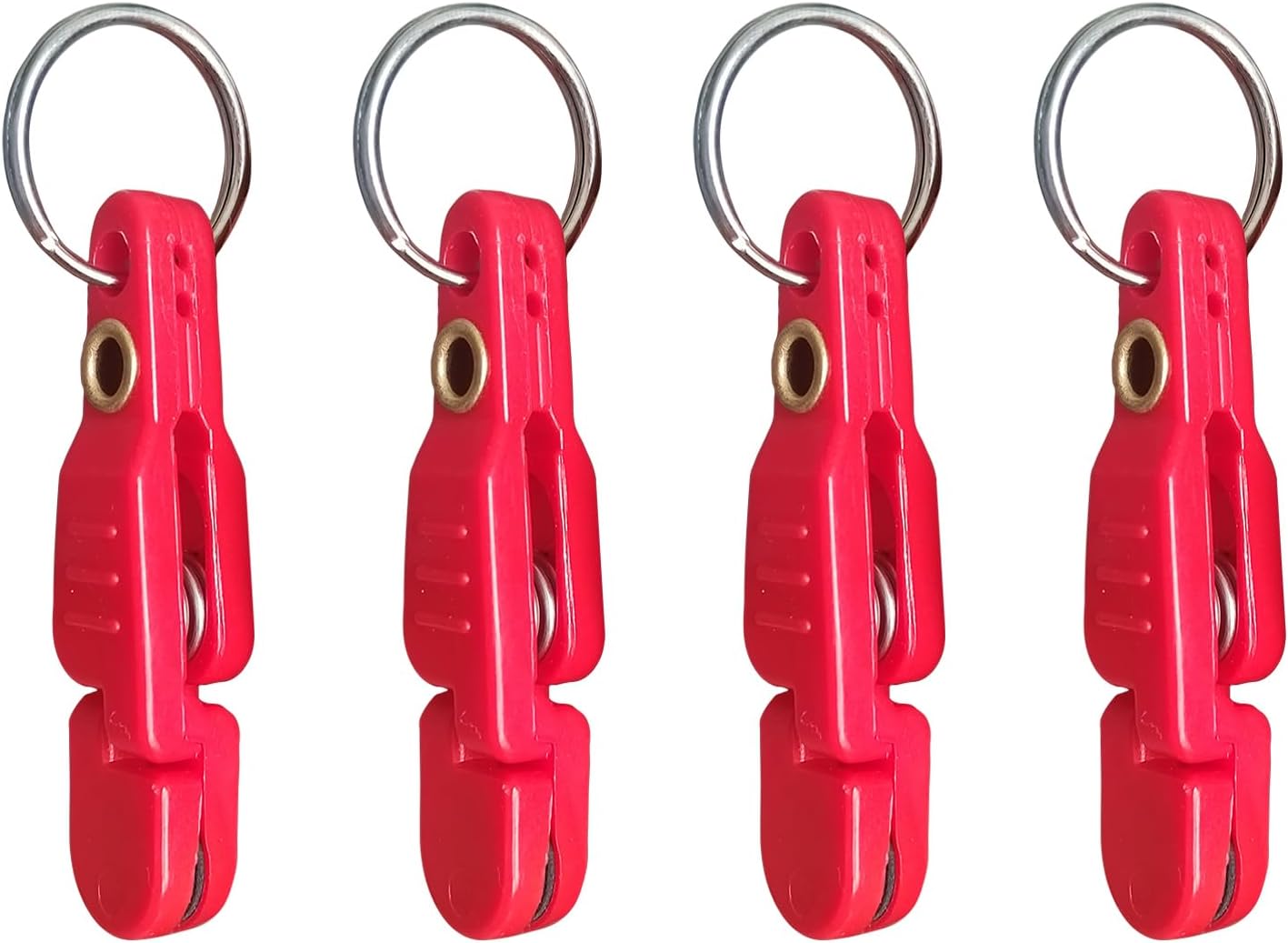
Snap weights are the depth-control answer for planer board lines. Rather than using lead core or copper line throughout the spool, you attach a clip-on weight at a specific distance behind the lure. The weight clips on with a release that pops free when a fish hits. This lets you adjust depth on the fly — change the weight size or position to fine-tune. Particularly useful when you’ve found fish at an unusual depth and need to adjust quickly without changing lines.
Gear to Pair with Planer Boards
- Best King Salmon Spoons — what to run off the boards
- Best Coho Salmon Lures — Husky Jerks for spring board work
- Best Salmon Trolling Rods — 8’6″ rods work for both downrigger and board lines
- Best Salmon Trolling Reels — line counters help track board distance
- Best Downriggers — boards and downriggers complement each other
- Salmon Trolling Guide — spread layouts including boards
- Sufix Lead Core Line — for board depth control
Frequently Asked Questions
Do I need planer boards for salmon fishing?
For spring shallow-water fishing, yes — there’s no efficient alternative for coho and brown trout in 5–25 feet of water. For summer downrigger fishing, boards are useful but optional. Most serious Great Lakes recreational anglers run both downriggers and boards as a complete system.
Inline or mast planer boards?
Inline boards (like Off Shore OR12 or Church Tackle TX-22) are the right choice for nearly all recreational anglers. Mast systems are charter-boat equipment that requires significant installation and operating skill. Inline boards are simpler, more flexible, and produce the same fish.
How far out do planer boards run?
50–150 feet from the boat depending on how much line you let out behind the board. Outside boards typically run 100–150 feet out. Inside boards run 50–80 feet. Stagger boards at different distances to spread your trolling coverage.
What’s the best planer board?
The Off Shore Tackle OR12 is the salmon and trout standard. The Church Tackle TX-22 is the walleye-specialized option that also works for salmon. Both are excellent; most anglers pick one brand and standardize.
How do I set release clip tension on planer boards?
Adjust the tension dial on the front release clip. Light tension for spring coho and walleye. Medium for brown trout and lake trout. Heavy for committed kings. Test by pulling line from the clip — it should release with firm pressure but not from chop or wave action.
Can planer boards be used for walleye?
Yes — planer boards are essential for walleye trolling, particularly on big water like Lake Erie. The Church Tackle TX-22 is specifically designed for walleye and is the dominant board in that fishery. The same technique used for salmon applies to walleye, just at slower trolling speeds (1.5–2.2 mph).
Plan Your Trip
- SST Charts — find temperature breaks
- Chlorophyll Maps — locate bait-holding water
- Fleet Tracker — see where boats are running
- Marine Weather — wind affects planer board operation
- AI Fishing Predictions — daily forecasts
- Lake Michigan Fishing Season Calendar
- Great Lakes Fishing Trips
Related Guides
- Best Water Temp for King Salmon
- Best Water Temp for Coho Salmon
- Best Water Temp for Atlantic Salmon
- Best Water Temp for Lake Trout
- Best King Salmon Spoons
- Best Coho Salmon Lures
- Best Downriggers
- Best Salmon Trolling Rods
- Best Salmon Trolling Reels
- Salmon Trolling Guide
- Lake Michigan Fishing Season Calendar
- Pier Fishing for Salmon
- River Salmon Fishing Guide
- Manistee River Salmon Fishing
- Great Lakes Fishing Trips
Tight lines!
Affiliate Disclosure: As an Amazon Associate, fishing-reports.ai earns from qualifying purchases. Links to Amazon on this page are affiliate links — if you click and buy, we may earn a small commission at no extra cost to you.