The rod is the most overlooked piece of a Great Lakes salmon trolling setup. Anglers obsess over reels, downriggers, and spoons, then put it all on a rod that’s wrong for the application — too stiff, too short, or built for the wrong line type. The result is missed strikes, broken-off fish, and a trolling spread that doesn’t perform to its potential. A purpose-built salmon trolling rod isn’t optional gear; it’s the connection between your spread and the fish.
This guide covers what makes a good salmon trolling rod and the specific models that produce on Great Lakes water. The right rod loads properly with a downrigger weight, telegraphs the strike clearly to the angler, and absorbs the runs of a 25-pound king without snapping. Pair this with the salmon trolling reels guide for matched setups.
⚡ Quick Picks by Situation
Best overall value: Okuma Classic Pro GLT — proven 8’6″ downrigger rod, the Great Lakes standard.
Best premium: Shimano Talora Trolling Rod — top-tier sensitivity and build quality.
For dipsy divers: Heavier-action rod in 9’–10′ — the Okuma Classic Pro GLT also offers heavier dipsy-specific models.
For planer boards: Medium-power rod, can use the same 8’6″ downrigger rod or a slightly lighter alternative.
For lead core: Slightly heavier rod with backbone to handle thick line and weight.
What Makes a Good Salmon Trolling Rod
Salmon trolling rods are purpose-built. The right rod has specific characteristics:
Length: 8’6″ is the standard for downrigger work. Some anglers run 9′ or 10′ rods on dipsy divers or planer boards, but 8’6″ is the most versatile choice. The length provides leverage for fighting heavy fish at the boat and helps absorb runs without break-offs. Anything shorter than 7’6″ doesn’t load properly with downrigger weights.
Action: Moderate to moderate-fast. Salmon trolling rods need a parabolic bend that loads with the downrigger weight and absorbs the strike. A fast-action rod transmits too much shock to the line; an extra-slow rod doesn’t load properly. Moderate is the sweet spot — the rod bends through the middle when loaded with a weight, giving you the right tension to detect strikes and the cushion to absorb runs.
Power: Medium for general salmon, medium-heavy for kings. Medium-power rods (rated for 12–25lb line) handle coho, browns, and Atlantic salmon well. For kings, medium-heavy (rated for 15–30lb line) is the better choice — bigger fish need more backbone. Specialized lake trout rods often step up to heavy power for deep water work.
Material: Graphite-composite blanks. Pure graphite is too sensitive and breaks; pure fiberglass is too soft. Modern salmon rods use a graphite-fiberglass composite that combines the responsiveness of graphite with the durability of glass. This is non-negotiable in the price range we’re discussing.
Guides: Stainless steel or aluminum oxide. Trolling rods see constant exposure to splash and weather. Cheap guides corrode and develop grooves that wear through line. Quality guides (Fuji or equivalent) last decades.
Roller tip or premium tip-top. Trolling produces constant friction on the tip guide as line pulls through it. A roller tip eliminates the wear entirely; a premium aluminum oxide tip-top works well for moderate use. Avoid plastic or cheap ceramic tips.
The Trolling Rods
Okuma Classic Pro GLT Salmon/Steelhead Rod
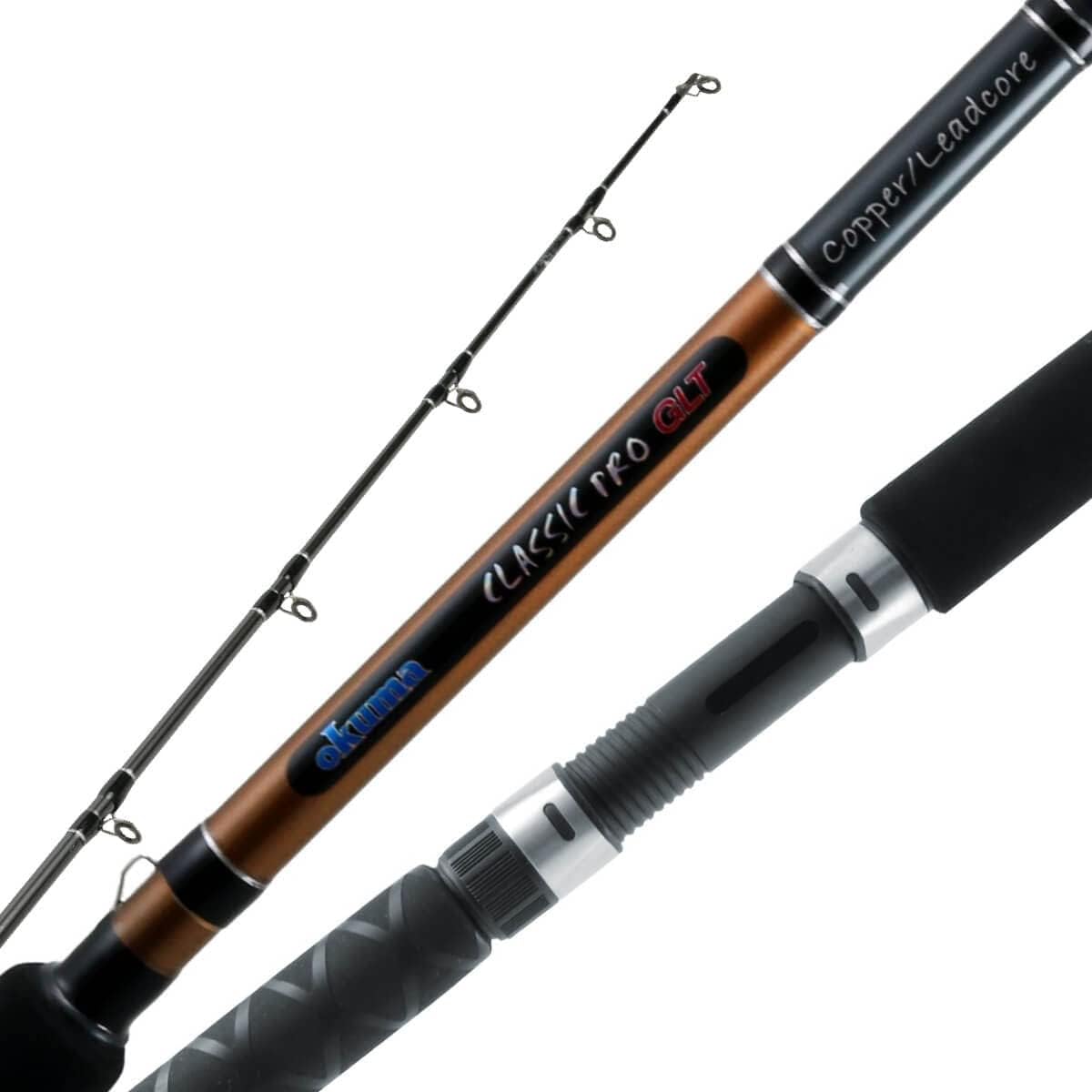
The Okuma Classic Pro GLT is the salmon trolling rod most anglers settle on after trying others. The graphite composite blank loads properly with a 10–12 lb downrigger weight, telegraphs the strike clearly when a fish takes, and absorbs the runs of mid-20-lb kings without break-offs. The 8’6″ Medium-Heavy is the most-used variant — rated for 15–30lb line and 1–4 oz lures. Stainless steel guides resist corrosion through years of Great Lakes use. The full cork handle stays grippy when wet. At around $80–110, this is the rod most Great Lakes anglers buy 4–6 of when building out a trolling spread. The Classic Pro GLT also comes in lighter versions for coho and brown trout work, and heavier versions for dipsy diver setups — letting you standardize on one rod family across your entire spread.
Shimano Talora Trolling Rod (8’6″ Medium)
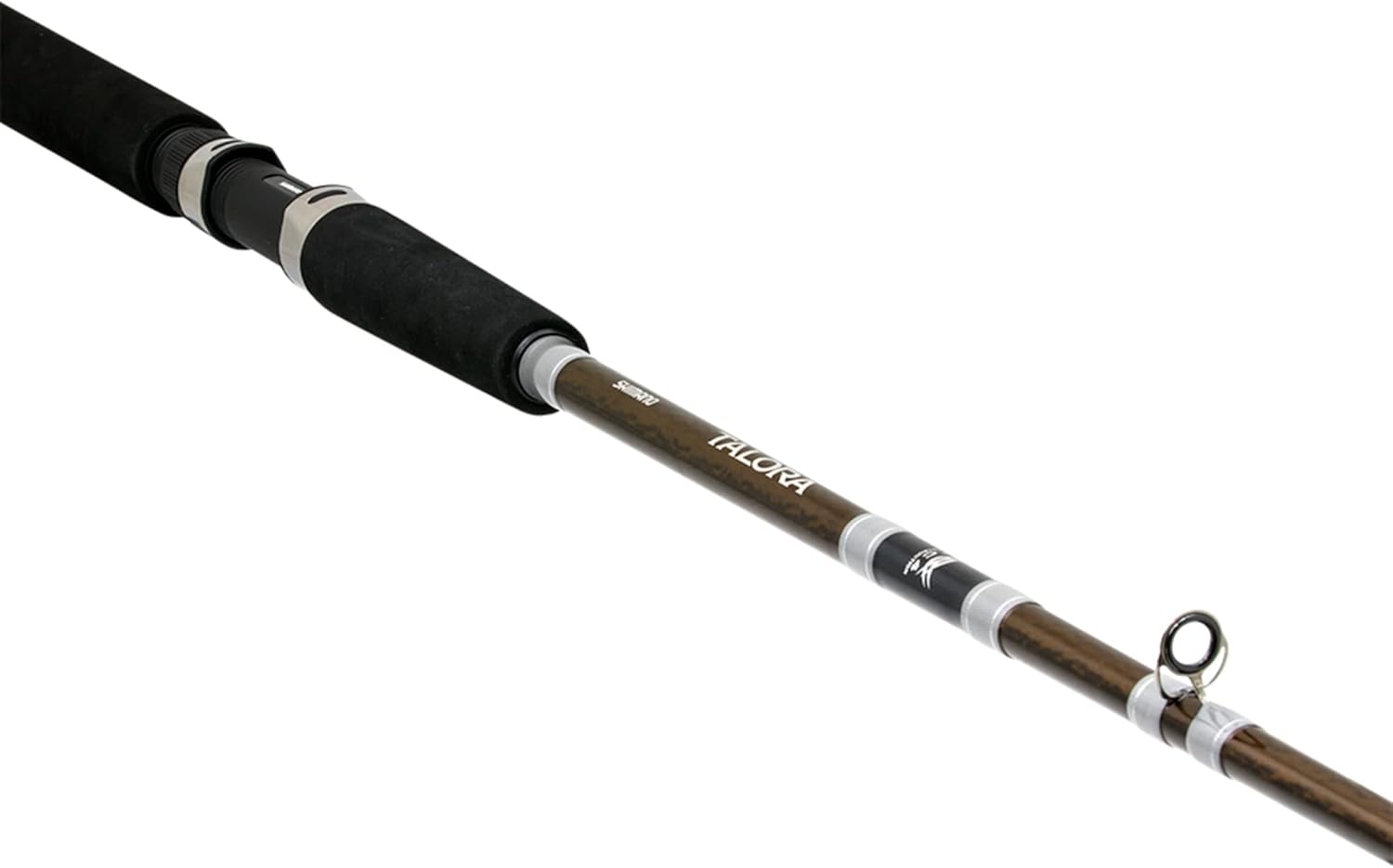
The Shimano Talora is the premium pick for serious Great Lakes anglers. Shimano’s blank technology produces a rod that’s noticeably more sensitive than entry-level competitors — you’ll feel a king investigating your spoon before the strike, where on a budget rod you’d only feel the actual hookset. The action is true moderate, loading uniformly through the rod under downrigger weight rather than hinging at one point. Build quality is excellent — Fuji guides, premium reel seat, full-length cork handle that’s comfortable for hours of fighting fish. The 8’6″ Medium handles everything from spring coho through summer kings. Stepping up to Medium-Heavy is the right call for anglers focused on big kings or running heavy dipsy divers. Priced at $150–230 depending on configuration, the Talora is the rod that justifies its cost over years of fishing — quality holds up where cheaper rods develop guide grooves and lose action.
Rod Setup by Position in the Spread
Different positions in the trolling spread benefit from slightly different rod specifications:
| Position | Rod Length | Action | Power |
|---|---|---|---|
| Downrigger (kings) | 8’6″ | Moderate | Medium-Heavy |
| Downrigger (coho, browns) | 8’6″ | Moderate | Medium |
| Dipsy diver | 9’–10′ | Moderate-Fast | Heavy |
| Planer board | 8’6″ | Moderate | Medium |
| Lead core / copper | 9’–10′ | Moderate | Heavy |
| Lake trout (deep) | 8’6″–9′ | Moderate-Fast | Heavy |
Most recreational anglers can build a complete spread with one rod family (like the Okuma Classic Pro GLT) in two variants: Medium-Heavy for the king-targeting downrigger positions, and Heavy for the dipsy diver and lead core positions. Matching brand and family makes the spread visually consistent in the rod holders and standardizes the feel.
Pairing Rod to Reel
Rod and reel need to balance properly. A heavy reel on a light rod feels nose-heavy and tiring; a light reel on a heavy rod feels under-spec’d. Recommended pairings:
- Okuma Classic Pro GLT MH + Okuma Convector CV-30DLX — the standard Great Lakes salmon trolling combo
- Shimano Talora Medium + Shimano Tekota — premium balanced setup, ideal for serious anglers
- Okuma Classic Pro GLT Heavy + larger Okuma or Daiwa Saltist — dipsy diver / lead core setup
- Talora Medium-Heavy + Penn Squall II 25N — premium rod, budget reel for downrigger positions
Common Mistakes
Using saltwater rods for trolling. Saltwater stand-up rods like the 7′ offshore rods work for casting and fighting, but their length and action aren’t ideal for downrigger trolling. Use purpose-built trolling rods.
Buying too stiff a rod. Anglers transitioning from bass or other fast-action fishing often buy rods that are too stiff for trolling. Salmon trolling needs moderate action to load with the downrigger weight and absorb strikes. A rod that doesn’t bend properly under weight isn’t doing its job.
Mixing rod lengths randomly. A spread with 7′ rods next to 9′ rods looks chaotic and creates inconsistent angles in the rod holders. Standardize on 8’6″ for downriggers and 9’–10′ for dipsy lines.
Cheap guides. Trolling rods see more constant water exposure than casting rods. Cheap guides develop wear and corrosion within a season or two. Pay for stainless or aluminum oxide guides — they last.
Not protecting the rod tip. The tip guide takes the most wear from line constantly running through it. Inspect annually and replace the tip-top if you see grooving. A worn tip-top can cut your line on the next big strike.
Caring for Your Trolling Rod
Trolling rods take more abuse than most fishing rods because they’re constantly under load. Routine care:
- Rinse with fresh water after each trip — Great Lakes water is fresh but still carries minerals that build up on guides
- Inspect guides for corrosion or wear — replace tip-tops at the first sign of grooving
- Wipe down the reel seat and tighten loose hardware annually
- Store rods vertically or horizontally — never bent against a wall
- Treat the cork handle with cork sealer annually to prevent cracking
Gear to Pair with Your Trolling Rods
- Best Salmon Trolling Reels — line counters for precise depth control
- Best Downriggers — what your rod is mounted to
- Best Planer Boards — for outside positions in the spread
- Best King Salmon Spoons
- Best Coho Salmon Lures
- Salmon Trolling Guide — putting the system together
- PowerPro Braid — mainline
Frequently Asked Questions
What’s the best salmon trolling rod?
The Okuma Classic Pro GLT in 8’6″ Medium-Heavy is the most-used and best-value pick. For premium quality, the Shimano Talora is the top-tier choice. Both are 8’6″ downrigger-rated rods with moderate action.
What length salmon trolling rod do I need?
8’6″ is the standard for downrigger positions and the most versatile length. Step up to 9’–10′ for dipsy diver and lead core positions where extra leverage helps manage the equipment. Anything shorter than 7’6″ doesn’t load properly with downrigger weights.
What action for salmon trolling rods?
Moderate action. The rod needs to load through the middle when bent with a downrigger weight and absorb the shock of a king’s strike. Fast action transmits too much shock; extra-slow doesn’t load properly. Moderate is the sweet spot for both detection and durability.
Medium or Medium-Heavy for kings?
Medium-Heavy is the right pick if you’re targeting kings primarily. Rated for 15–30lb line and 1–4 oz weights, MH handles heavy downrigger weights and 25-pound fish without strain. Step down to Medium for coho-focused fishing where lighter strikes need a more sensitive tip.
How many trolling rods do I need?
Most Great Lakes recreational setups run 4–8 rods. Two on each downrigger, two dipsy divers, two planer boards is a complete spread. Start with 4 if you’re new to trolling — two downriggers and two dipsies covers most situations.
Can I use a casting rod for trolling?
You can fish them, but casting rods aren’t designed for the constant load of trolling. The action and length aren’t right, the guides aren’t sized for trolling line, and the reel seats often don’t fit trolling reels properly. Purpose-built trolling rods are worth the investment.
Plan Your Trip
- SST Charts — find temperature breaks
- Chlorophyll Maps — locate bait-holding water
- Fleet Tracker — see where charters are working
- Marine Weather — wind and wave conditions
- AI Fishing Predictions — daily forecasts
- Lake Michigan Fishing Season Calendar
- Great Lakes Fishing Trips
Related Guides
- Best Water Temp for King Salmon
- Best Water Temp for Coho Salmon
- Best Water Temp for Lake Trout
- Best King Salmon Spoons
- Best Coho Salmon Lures
- Best Downriggers
- Best Planer Boards
- Best Salmon Trolling Reels
- Salmon Trolling Guide
- Lake Michigan Fishing Season Calendar
- Best 7-Foot Offshore Rods (SoCal)
- Best 8-Foot Offshore Rods (SoCal)
- Graphite vs Fiberglass Rods
- Best Rod & Reel Combos
- Great Lakes Fishing Trips
Tight lines!
Affiliate Disclosure: As an Amazon Associate, fishing-reports.ai earns from qualifying purchases. Links to Amazon on this page are affiliate links — if you click and buy, we may earn a small commission at no extra cost to you.