
River salmon fishing on the Great Lakes is its own distinct fishery. The fish are the same kings and coho that anglers troll for offshore in summer, but the techniques, gear, and tactics are entirely different. Once kings push out of the lake and into tributaries to spawn — typically mid-August through October — they stop feeding the way they did in open water. They strike out of aggression and spawning instinct, not hunger. The lures that produce shift dramatically. Your downrigger rod becomes useless. The fish become harder to catch and easier to spot at the same time.
This guide covers what works for river salmon across Great Lakes tributaries — drift fishing, float fishing, plug fishing, bead drifting, and fly techniques. It applies to the Manistee, Pere Marquette, Salmon River, Niagara, Big Manistee, and dozens of other tributaries that run salmon. For region-specific information, see the Manistee River guide and the Lake Ontario guide.
⚡ Quick Picks by Technique
Drift fishing plugs: Kwikfish K15 — the river plug standard.
Alternative plug: Yakima Mag Lip 3.5 — modern alternative to Kwikfish.
Casting: Mepps Aglia #4 or #5 — the river spinner standard.
Smaller water: Rapala Original F05 — tight wobble for educated fish.
Distance casting: Acme Kastmaster 1 oz — casts a mile, deadly on bigger water.
Understanding River Salmon
The biggest mental shift for river salmon fishing is recognizing that the fish aren’t feeding. Lake salmon hunt — they chase bait, they strike to eat. River salmon don’t. By the time they enter the rivers, they’ve already begun the metabolic shift to spawning. Their digestive system is shutting down. They strike for two reasons only:
Aggression / territory. A spawning king will hammer a plug that invades the holding water. This is the primary trigger for plug fishing.
Egg-eating instinct. Throughout their life, salmonids eat each other’s eggs. In rivers, this instinct stays active even after they stop feeding generally. This is the primary trigger for bead and egg fishing.
Once you understand this, the techniques make sense. You’re not trying to make a salmon hungry — you’re trying to make them mad enough or instinct-driven enough to strike.
Reading Rivers for Salmon
Where salmon hold in a river changes by stage of run:
Fresh fish (chrome). Recently entered from the lake. Bright, silver, still ocean-conditioned. Holding in deeper pools and current seams, often resting between push periods. Most aggressive bite — these fish still have some feeding response left.
Staging fish. Holding in pools waiting for water conditions to push them upstream. May stay in the same hole for days. Most accessible to anglers because they’re stationary.
Pre-spawn (dark). Beginning to color up. Holding near suspected spawning gravel. Selective biters, but aggressive on plugs that invade their space.
Spawning fish. On gravel beds (redds). Should be left alone — Michigan and most other states prohibit fishing for actively spawning fish. Fish the water below redds where post-spawn drop-back fish hold.
Look for these features when reading a river:
- Deep pools below riffles — Where fresh fish rest after pushing through fast water
- Current seams — Edges between fast and slow water concentrate fish
- Log jams and undercut banks — Shelter for staging fish, particularly larger kings
- Tailouts of pools — The downstream lip where pools shallow before the next riffle. Fish stage here before moving up.
- Boulder fields — Pockets behind individual boulders break the current and hold fish
Drift Fishing with Plugs
The dominant technique on the bigger Great Lakes tributaries. A boat anchors or holds position upstream of a known holding pool, and a plug drifts back into the strike zone on a controlled line. When a king hits, it’s an unmistakable rod-bender.
Kwikfish K15
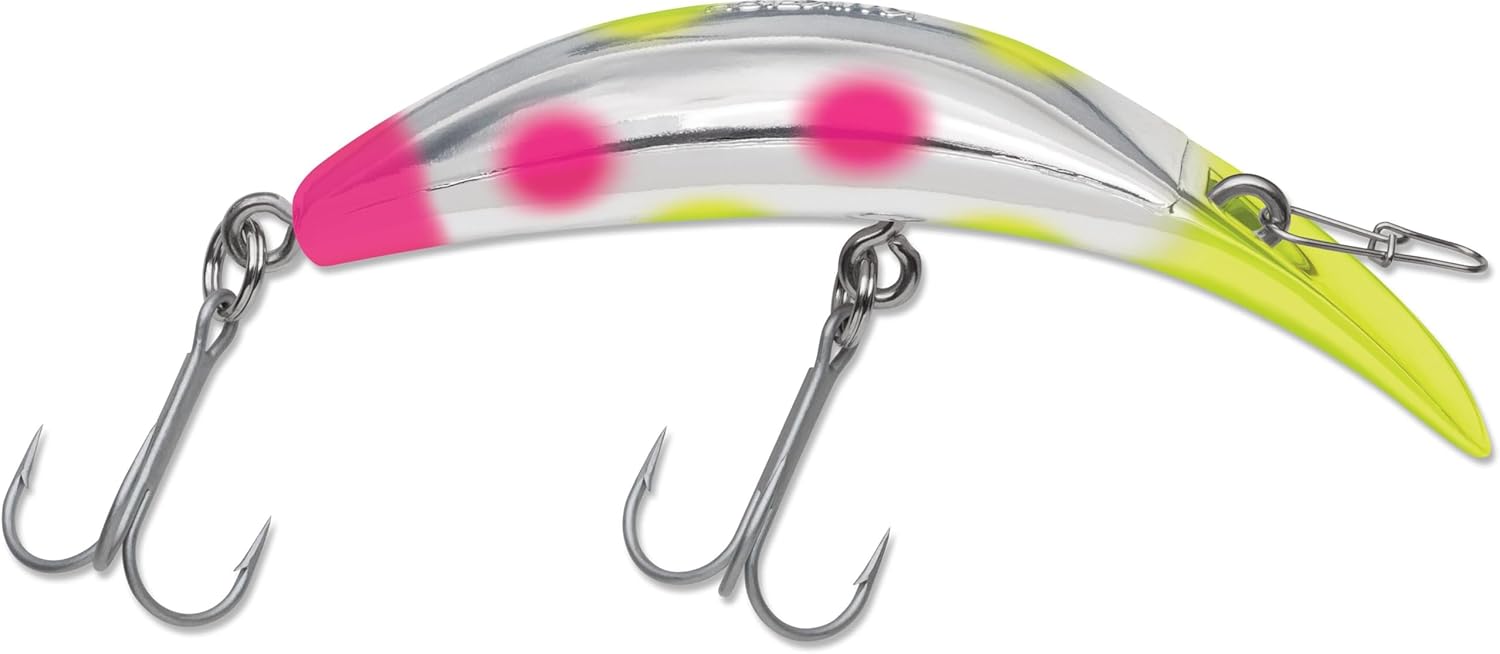
The Kwikfish K15 is the classic salmon drift plug. The size (about 5″) matches what kings react to in river conditions. The wobble is aggressive — wider and more erratic than spoons — which triggers strikes from territorial fish. Most river anglers wrap the plug with a sardine or herring wrap (a strip of bait secured around the body with thread) which adds scent attraction and slows the action slightly for better presentation. Run with a long fluorocarbon leader (8–12 feet) to keep the line out of the strike zone. Colors that produce: chartreuse, fluorescent orange, pink/chartreuse, and the classic “Hot Tamale” pattern. Drift slowly through holding water — the plug should wobble seductively without spinning out.
Yakima Mag Lip 3.5
The Yakima Mag Lip is the modern alternative to the Kwikfish. The lip design produces a tighter, more consistent wobble than the Kwikfish, which some anglers prefer for educated fish on pressured water. The 3.5 size matches the K15 for application. Mag Lips also accept bait wraps. Colors run similar to Kwikfish patterns. Some river anglers swear by Mag Lips; others stay loyal to Kwikfish. Carry both — when one color or action isn’t producing, switch to the other and you often find what’s working.
Float Fishing
Float fishing — sometimes called centerpin fishing or bobber fishing — drifts a presentation at a set depth through holding water. The float (bobber) marks the location, the leader sets the depth, and the lure or bait drifts naturally with the current. Steelhead anglers are the masters of this technique, but it works for salmon too.
Setup: a long rod (10–13′), small bobber sized to the current and bait, 4–6 feet of fluorocarbon leader, and your bait. The bait can be:
- Spawn bags — Cured salmon eggs in mesh netting. The most-used bait.
- Beads — Plastic beads in colors that match natural salmon eggs (orange, peach, mottled pink). Pegged 1–2 inches above a single hook so the bead floats freely.
- Glo bugs — Yarn flies tied to imitate single eggs. Cross between fly and bait fishing.
- Pink worms — Soft plastic worms in pink/red. Drift naturally and trigger reaction strikes.
Drift the float through the suspected holding water. When the float goes down, set the hook with a long sweep — circle hooks especially require steady pressure rather than a hard hookset.
Spinner and Spoon Casting
Casting from shore or wading. The fundamental technique on smaller rivers and pier-adjacent stretches.
Mepps Aglia #4 or #5
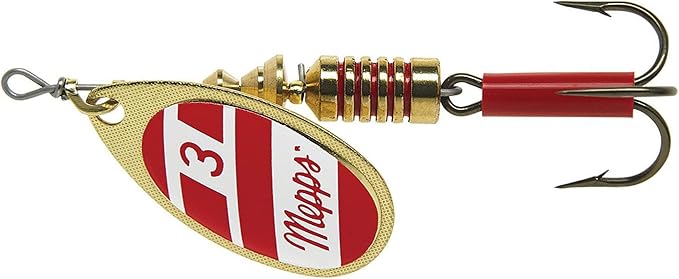
The Mepps Aglia in #4 or #5 size is the universal river spinner for salmon and steelhead. Cast across and slightly downstream, then retrieve at a moderate pace as the current sweeps the spinner across holding water. The rotating blade creates flash and vibration that triggers reaction strikes from aggressive fish. Silver blade with red dressing is the classic. Fluorescent orange and chartreuse for stained water. Replace the standard treble with a single hook for catch-and-release water — easier to release fish unharmed.
Rapala Original F05 / F07

The Original Rapala in F05 (2″) or F07 (2.75″) is the small-river alternative to the Mepps. Where the spinner gives you flash, the Rapala gives you a more bait-like tight wobble. Particularly effective in clear water or when fish are pressured and rejecting spinners. Twitch the rod tip during the retrieve to give the lure erratic action. Silver/black and gold/orange are classic colors.
Acme Kastmaster 1 oz

The Kastmaster’s distance is its primary virtue. On bigger rivers where you need to reach the far bank or a holding pool 80 feet out, no spinner will get there. The Kastmaster will. The action is simpler than spinners — a tight wobble on retrieve, fluttering fall on the drop — but it triggers strikes consistently from staged salmon. Chrome/blue and chrome/red are the standard colors. Replace the factory hook with an upgraded single or treble.
Fly Fishing for River Salmon
Fly fishing for Great Lakes salmon and steelhead has a dedicated following, particularly on the Manistee, Salmon River, and Pere Marquette systems. Two main approaches:
Single-hand fly rods (8–10 wt) for traditional river fly fishing. Standard fly casting technique. Fly patterns include intruders (large hair-and-flash flies for kings), egg patterns (single egg imitations), stoneflies (large nymphs), and streamers.
Two-hand spey rods (11–13 ft) for swinging flies through long runs. Spey casting allows long, accurate casts in confined spaces. Particularly effective on bigger rivers like the Salmon River and the Big Manistee.
Fly fishing requires more learning curve than spinning gear, but produces excellent results on pressured water where conventional anglers have struggled. The “swung fly” approach — letting the fly drift across the current at swimming depth — often produces strikes from fish that have refused everything else.
River Salmon Gear Setup
Match gear to water size and technique:
| Technique | Rod | Reel | Line |
|---|---|---|---|
| Drift fishing plugs (boat) | 8’–9′ medium-heavy | Line counter conventional | 30lb braid + 25lb mono leader |
| Casting (shore) | 8’6″–9′ medium-heavy spinning | 5000–6500 spinning | 20lb braid + 15lb fluoro leader |
| Float fishing | 10’–13′ float rod | Centerpin or large spinning | 8–10lb mono mainline + 6–10lb fluoro |
| Single-hand fly | 9’–10′ 8–10 wt | Large arbor fly reel | WF8–10 floating + sink tips |
| Two-hand spey | 11’–13′ 7–9 wt spey | Spey-specific large arbor | Skagit or scandi head |
What to Bring
- Rod and reel matched to chosen technique
- Chest waders + wading boots with felt or cleated soles
- Wading staff for current safety
- Polarized glasses — essential for spotting fish
- Large rubber-mesh landing net
- Tackle: Kwikfish, Mepps, beads, spawn bags, leader material
- Fishing pliers, line clippers, hook hone
- Layered clothing (river mornings get cold)
- Headlamp for pre-dawn / post-sunset fishing
- Snacks, water, and cash for parking fees or pay access
Etiquette and Conservation
River salmon fishing has its own ethics:
- Don’t crowd other anglers — Give space, particularly at pools and runs
- Rotate through holes — On busy water, take turns rather than camping a single spot
- Avoid actively spawning fish — Illegal in most states; ethical even where legal
- Practice catch-and-release on dark fish — Fish that have colored up are spawning fish; bright chrome is fresh
- Pack out everything — Including used spawn sacks and leader trimmings
- Respect private property — Some river sections have private banks; know boundaries
Frequently Asked Questions
When is the fall salmon run?
Mid-August through late October for kings. Coho follow with peak runs in late September and early October. Steelhead extend the river fishery into November and through winter into spring. Peak king window is the second week of September through the first week of October.
What’s the best technique for river salmon?
Depends on the river and your access. From a boat on bigger rivers like the Manistee: drift fishing wrapped Kwikfish K15. From shore casting: Mepps Aglia spinners. From float fishing setups: beads or spawn bags. Each technique has its place.
Do salmon feed in rivers?
Not in the traditional sense. River salmon are in pre-spawn or spawning mode and their digestive system has largely shut down. They strike from aggression (territorial) or instinct (egg-eating), not hunger. This is why lures that mimic eggs or invade their space produce, while lures that mimic baitfish (which work in the lake) are less effective.
Are river salmon as big as lake salmon?
Slightly smaller on average. Fish that have made the migration burn weight on the journey. A 20–25 lb king is excellent for the river; 30+ lb fish are more common in the lake during pre-spawn staging.
Do I need waders for river salmon fishing?
Yes for most situations. Chest waders give the most flexibility for accessing productive water. Wading staff helps in current. Some fishing from boats and bigger bridges doesn’t require waders, but the majority of river salmon fishing involves wading.
Can I fly fish for Great Lakes salmon?
Yes — there’s a strong fly fishing tradition for kings, coho, and steelhead. Two-handed spey rods are particularly popular for swinging flies through larger water. Single-hand 8–10 weight rods work for smaller rivers and traditional techniques.
Plan Your Trip
- SST Charts — find Lake Michigan staging temps before fish push to rivers
- Chlorophyll Maps
- Fleet Tracker — Lake-side fishing tracker
- Marine Weather — rain affects river levels significantly
- AI Fishing Predictions
- Lake Michigan Fishing Season Calendar
- Great Lakes Fishing Trips
Related Guides
- Best Water Temp for King Salmon
- Best Water Temp for Coho Salmon
- Best Water Temp for Atlantic Salmon
- Best King Salmon Spoons
- Best Coho Salmon Lures
- Best Salmon Trolling Rods
- Best Salmon Trolling Reels
- Best Downriggers
- Best Planer Boards
- Salmon Trolling Guide
- Manistee River Salmon Fishing
- Lake Ontario Salmon Fishing
- Pier Fishing for Salmon
- Lake Michigan Fishing Season Calendar
- Great Lakes Fishing Trips
- Best Fishing Knots
Tight lines!
Affiliate Disclosure: As an Amazon Associate, fishing-reports.ai earns from qualifying purchases. Links to Amazon on this page are affiliate links — if you click and buy, we may earn a small commission at no extra cost to you.