Trolling spoons are the foundation of Great Lakes king salmon fishing. Spend any time on a charter boat out of Manistee, Ludington, or Sheboygan and you’ll see the same three or four brands cycling through the rotation: Moonshine, Michigan Stinger, Dreamweaver, with a few regional favorites in the mix. The reason is simple — these spoons have decades of proven catches on Great Lakes kings, and their colors, sizes, and actions are tuned specifically for this fishery.
This guide covers what actually works for kings: the spoon brands and patterns that fill coolers, the size selection that matches the season, the colors that produce in different water clarity, and what to pair them with. If you’re new to Great Lakes trolling and trying to figure out where to start your spoon collection, this is the shortcut. Cross-reference the king salmon temperature guide to know what depth to put these in.
⚡ Quick Picks by Situation
Best overall: Moonshine RV Series — the Great Lakes standard, Carbon 14 is iconic.
Standard trolling: Michigan Stinger Stingray — 3.75″ is the most-used king size.
Picky fish / clear water: Dreamweaver Super Slim — tighter wobble for educated kings.
Attractor / flasher combo: Pro-Troll ProChip 11 Flasher — run ahead of any spoon for hot bite days.
Budget producer: Loony Trolling Spoon — proven catch rate at a fraction of the premium brands.
Now here’s what each spoon does, when to throw it, and how to set up your spread.
Standard Trolling Spoons
Moonshine Lures RV Series Spoon
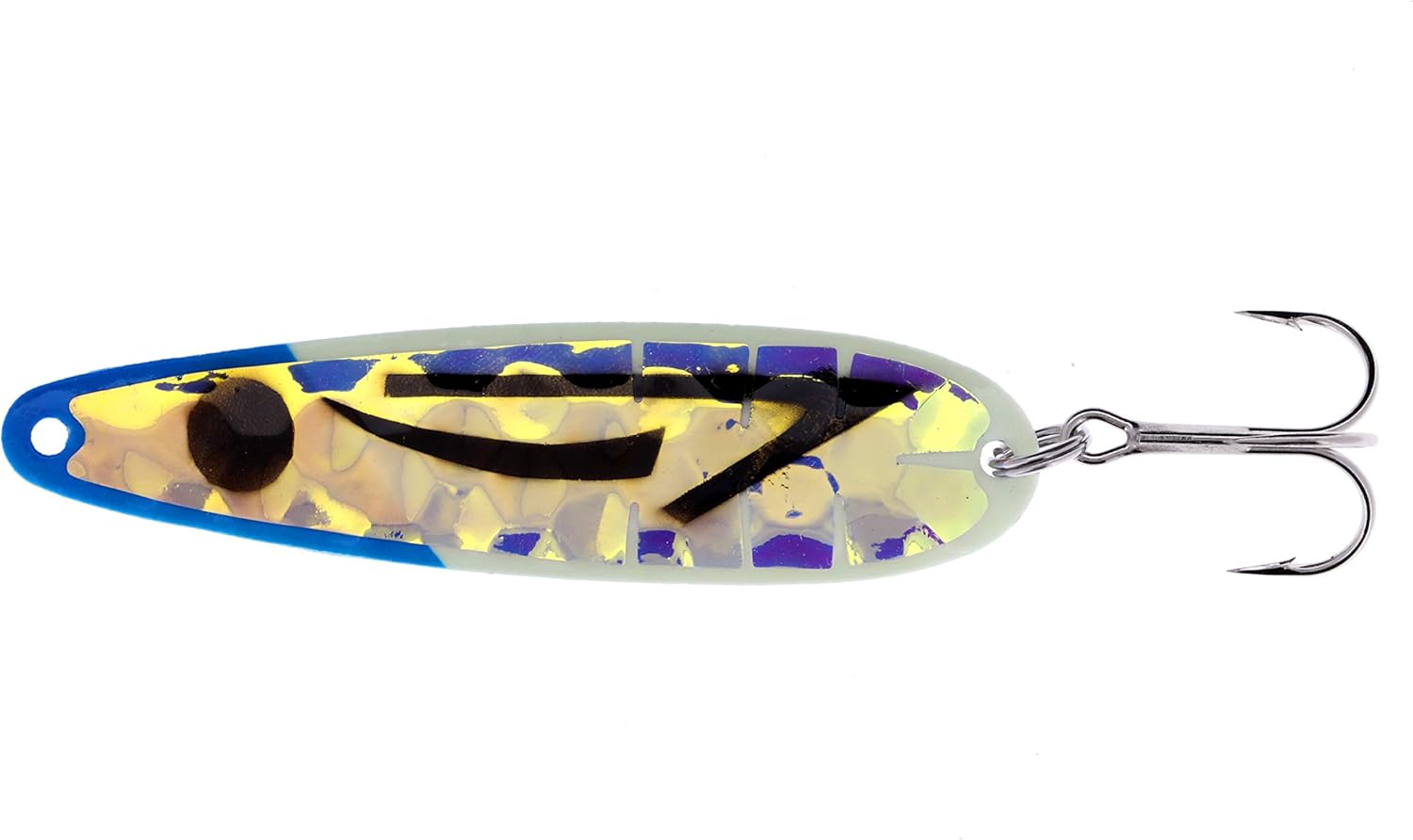
The Moonshine RV Series is the SoCal-equivalent legendary spoon for Great Lakes kings — the same way the Tady 45 owns yellowtail water out west. The RV refers to “reverse vinyl,” a specific tape pattern that glows under UV light and continues attracting fish in low-light conditions. Carbon 14 is the iconic color — black ladder back with green/UV elements — and it produces from dawn through bright daylight. The spoon has a wider wobble than most competitors, which throws more flash and triggers strikes on lethargic fish. Run at 2.4–2.6 mph, 60–100 feet down on downriggers or behind dipsy divers. Replace the factory treble with an Owner ST-66 in 2/0 — most charter captains do this immediately when the spoon comes out of the package. Other proven colors: Wonderbread, Sully (chartreuse), Frog.
Michigan Stinger Stingray Spoon (3.75″)
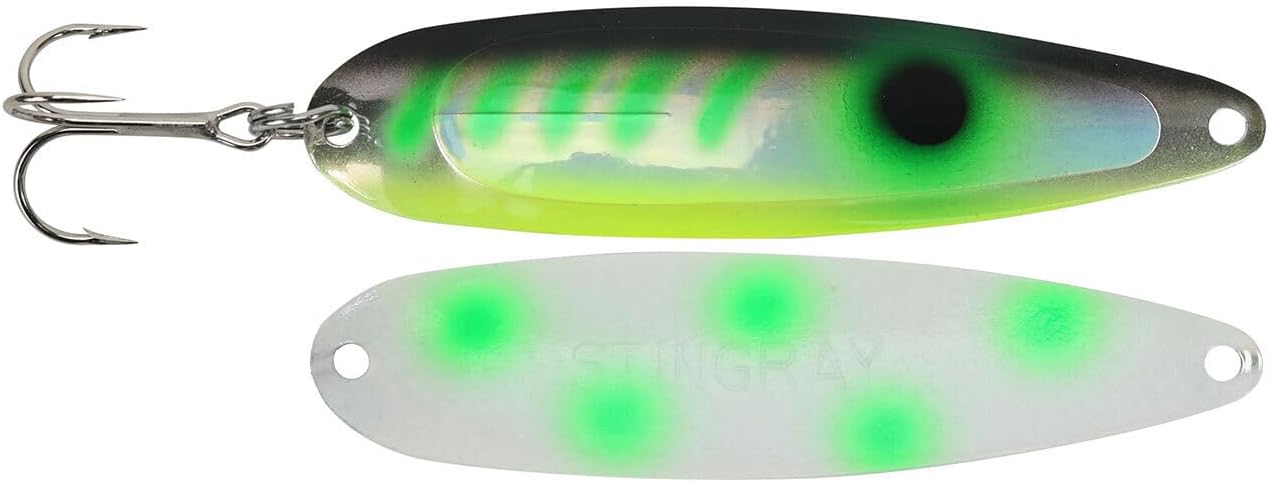
If Moonshine owns the dawn bite, Michigan Stinger owns the midday grind. The Stingray 3.75″ is the most-used king salmon spoon size across the entire Great Lakes fleet — it’s the size that matches the alewife forage base in late summer, and the action runs perfectly at the 2.4–2.8 mph trolling speeds kings prefer. Stinger’s color selection is unmatched: blue/silver, green/UV, mixed veggie, and the “Carbon Lemon Ice” pattern produce on Lake Michigan specifically. Like Moonshine, Stinger’s factory trebles are functional but most anglers upgrade to Owner ST-66s. The Stingray’s action is slightly tighter than the RV, which makes it the better pick when kings are following but not committing — the tighter wobble triggers reaction strikes on educated fish. Build your spread with 2–4 Stingrays in different colors to find the daily pattern.
Dreamweaver Super Slim Spoon
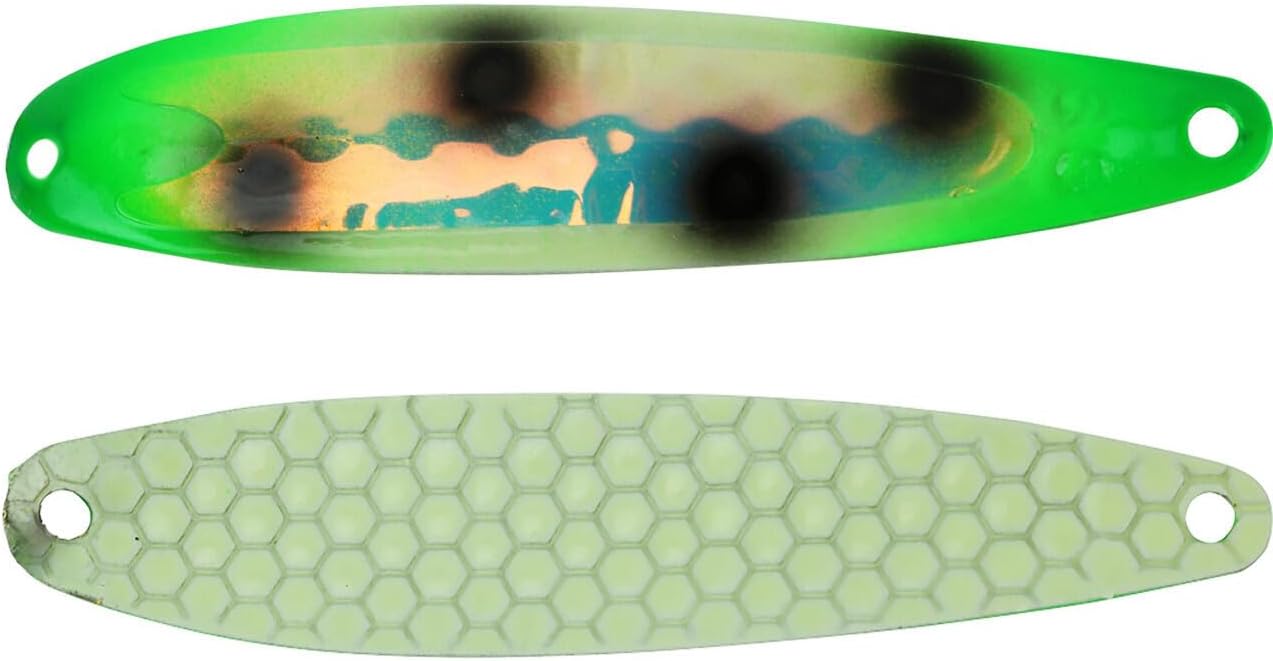
The Super Slim is the finesse option in the three-spoon king salmon arsenal. Narrower body, tighter wobble, and a more subtle profile than the RV or Stingray make it the spoon to throw when other patterns are getting follows but no commits. The Super Slim shines in clear water and on bright sunny days when kings get cautious. It also runs cleaner at higher speeds — if conditions push your trolling speed up to 2.8–3.0 mph (which happens with current or wind chop), Super Slims maintain their action while wider spoons start to spin out. Mountain Dew, Watermelon, and Carbon 14 colors are reliable Lake Michigan producers. Pair with a flasher for kings that are deep and skeptical.
Loony Trolling Spoon

The Loony is the value option that consistently surprises people. It’s cheaper than the premium brands, the finishes aren’t as refined, and the packaging looks like a 1990s tackle shop bin. But the action is solid, the colors hit the key Great Lakes patterns, and the catch rate competes with spoons that cost three times as much. For anglers building out a spread on a budget, or for stocking the boat with backup spoons after losing a few to break-offs, the Loony deserves a place in the box. Run them on the secondary lines or behind your premium spoons until you find what’s producing — then you’ll know if the day calls for stepping up to a Moonshine or if the Loony is doing the job just fine.
Flashers and Attractors
Flashers are the multiplier. On hot bite days, kings will hit a bare spoon all day long. On tough days — and most Great Lakes salmon days have at least some toughness in them — a flasher run 24–36 inches ahead of the spoon dramatically increases your strike rate. The flasher creates flash and vibration that pulls kings from outside the spread, and the spoon trailing it gets the strike.
Pro-Troll ProChip 11 Flasher
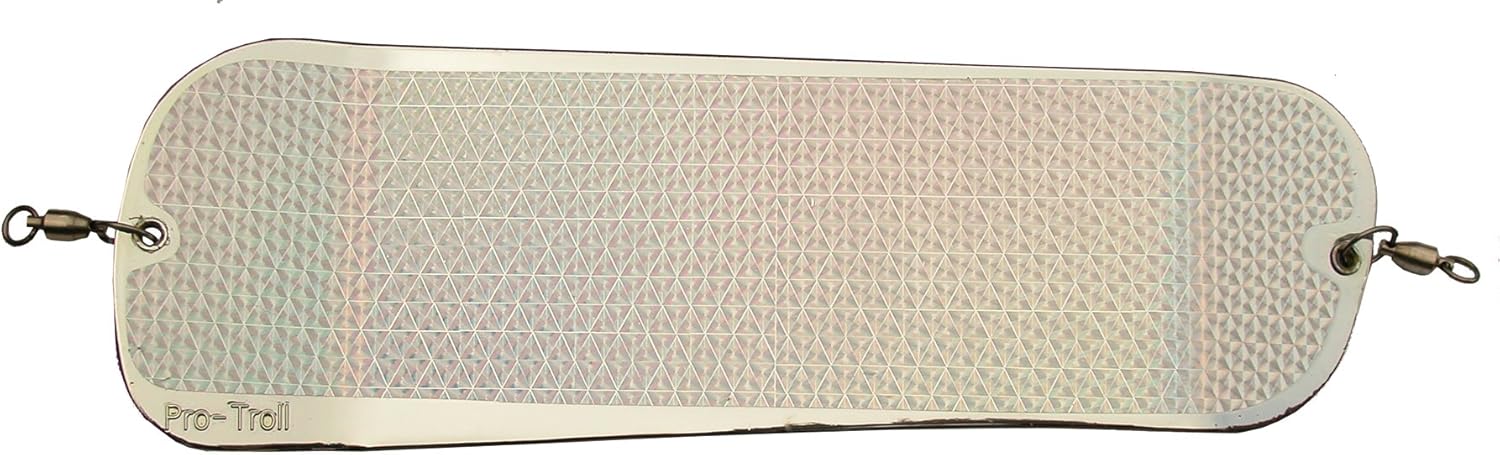
The ProChip 11 is the standard 8″ flasher for Great Lakes kings. The size produces strong flash and vibration without overwhelming the spoon trailing behind it. Pro-Troll’s “EChip” technology — a small battery-powered chip that emits a low-voltage electrical signal — is the differentiator. Whether or not the EChip adds fish-attracting bio-electrical signals is debated among captains, but the spoons work consistently and have a loyal following on the fleet. Run 24–36 inches behind the flasher on a heavy fluorocarbon leader. The most productive colors on Lake Michigan are Glo White, Mountain Dew, and UV Crinkle. Replace the snap swivel with a heavier ball-bearing version if you’re targeting trophy kings — the standard hardware has been known to fail on big fish.
Dodger Assortment

Dodgers are the lower-action alternative to flashers — they sway side-to-side rather than rotating, creating a more subtle attraction. Dodgers work well in clear water and on educated fish where a full flasher might be too aggressive. They also pair better with cut plugs and certain bait rigs that need a tighter trailing line to work properly. A starter dodger assortment gives you Lake Michigan-relevant colors at a fraction of the cost of buying individual premium dodgers. Run 18–28 inches ahead of your trailing lure on a slightly stiffer leader than you’d use with a flasher.
Spoon Color Selection by Conditions
Color matters more in salmon trolling than most people realize. Charter captains will switch colors aggressively until they find what’s producing on a given day. Some patterns:
| Conditions | Best Colors | Why |
|---|---|---|
| Dawn / Low Light | Black/Glow, UV patterns, Carbon 14 | Glow patterns charge up at dawn light, UV reflects pre-sunrise spectrum. |
| Bright Sun / Clear Water | Blue/Silver, Green/Silver, natural alewife | Mimics live bait colors, less aggressive flash for educated fish. |
| Bright Sun / Cloudy Water | Chartreuse, Orange, Hot Pink | High visibility through stained water, triggers reaction strikes. |
| Overcast / Stained Water | Chartreuse, Mountain Dew, Wonderbread | Bright colors penetrate, contrast matters more than realism. |
| Deep Water (100+ ft) | Glow patterns, UV, Carbon 14 | Most natural colors disappear at depth. Glow and UV still produce. |
Spoon Size and Depth Pairing
Spoon size should match the bait kings are feeding on. On Lake Michigan, that’s primarily alewives — which run 3–5 inches in summer. Your spoon should match that profile. The Stingray 3.75″ is exactly in that range, which is why it’s so productive.
- 3.0″ spoons — Spring and early summer when kings feed on smaller bait. Coho mix in.
- 3.75″ spoons — The standard king size. Summer through fall. Most productive across all conditions.
- 4.0–4.5″ spoons — Late summer / pre-spawn when kings are committed and looking for bigger meals. Larger trophy kings.
- Magnum 5″+ spoons — Specialized use for very deep water and trophy targeting. Not necessary for typical king fishing.
How to Set Up Your Spoon Spread
A typical king salmon spread runs 6–10 lines off a charter boat. Recreational anglers can produce well with 4–6. The mix matters more than the count:
- Downriggers (2–4 lines) — Set at thermocline depth. Run your most reliable spoons here. See downrigger setup guide.
- Dipsy divers (2–4 lines) — Set wider than the boat to spread your strike zone. Run spoons or flasher/spoon combos.
- Lead core or copper (1–2 lines) — Reaches mid-depth without downriggers. Good for back-of-boat coverage.
- Planer boards (optional) — Spring/early summer or shallow conditions. See planer board guide.
Pair your reels and rods correctly: line counter reels on 8’6″ downrigger rods. See the full salmon trolling guide for spread layouts and trolling speeds.
Common Mistakes
Running the same color on every rod. Kings change preferences within an hour. Your spread should have 3–4 different patterns at any time. When one starts producing, you can swap others to match.
Not replacing factory hooks. Most premium spoon manufacturers ship with adequate but not exceptional trebles. Upgrading to Owner ST-66 trebles in 2/0 dramatically improves hookup-to-landing ratios on kings.
Trolling speed wrong for the spoon. Wider-action spoons (Moonshine RV) work best at 2.4–2.6 mph. Tighter spoons (Super Slim) work up to 3.0 mph. If you switch spoons, check the action behind the boat — spoons that aren’t running right won’t catch fish.
Skipping the flasher on tough days. Bare spoons work in active conditions. When the bite is slow, the flasher/spoon combo doubles or triples strike rates.
Cheap leader on flashers. The hardware on flasher-to-spoon connections takes the brunt of strikes. Don’t skimp on swivels or leader — use 30lb fluorocarbon minimum with quality ball-bearing swivels.
Gear to Pair with Your Spoons
Spoons are one piece of the system. The full setup:
- Best Salmon Trolling Reels — line counters for precise depth setting
- Best Salmon Trolling Rods — 8’6″ downrigger rods with proper action
- Best Downriggers — Cannon and Scotty are the standards
- Best Planer Boards — for spring shallow water
- Salmon Trolling Guide — speed, depth, spread layouts
- Sufix Lead Core Trolling Line — for non-downrigger depth
- Braid vs Mono vs Fluorocarbon — leader selection
Frequently Asked Questions
What are the best spoons for king salmon?
The three brands that dominate the Great Lakes fleet are Moonshine Lures RV Series, Michigan Stinger, and Dreamweaver Super Slim. Each has slightly different action and color selections; most serious anglers carry all three. Start with a few of each in proven Great Lakes patterns like Carbon 14, Wonderbread, and Mountain Dew.
What size spoon for kings?
The 3.75″ size matches the alewife forage base on Lake Michigan and is the most productive across conditions. Step down to 3.0″ for spring and early summer when bait is smaller, step up to 4.0″+ for late summer pre-spawn fish targeting bigger meals.
What’s the best spoon color for king salmon?
Depends on light and water clarity. Carbon 14 (black ladder back with green/UV) is the most reliable single color across conditions. For dawn, add Glow or UV patterns. For bright sun and clear water, blue/silver and green/silver. For stained water or overcast, chartreuse and Wonderbread. Build a spread with 3–4 different patterns to find the daily preference.
Do I need a flasher for king salmon?
Not always, but it dramatically increases strike rates on slow days. The Pro-Troll ProChip 11 is the standard 8″ flasher. Run it 24–36 inches ahead of your spoon on heavy fluorocarbon. On active days, bare spoons produce; when the bite slows, the flasher/spoon combo finds fish that wouldn’t hit a spoon alone.
How fast should I troll spoons for kings?
2.4–2.6 mph is the standard king trolling speed. Wider-action spoons like the Moonshine RV work best in this range. Tighter-action spoons like the Dreamweaver Super Slim can run faster, up to 3.0 mph if current pushes you there. Always check the spoon action behind the boat — if it’s not running right, slow down or speed up.
How deep should I run spoons for kings?
Depends on the season and thermocline depth. Spring: 15–35 feet. Early summer: 30–60 feet. Peak summer: 60–120 feet. Pre-spawn (August): 40–80 feet. See the king salmon temperature guide for detail. Use a temp/speed probe at downrigger depth to find the prime 52–56°F band.
Plan Your Trip
- SST Charts — find temperature breaks
- Chlorophyll Maps — locate bait-holding water
- Fleet Tracker — see where charters are working today
- Marine Weather — wind and wave conditions
- AI Fishing Predictions — daily forecasts
- Lake Michigan Fishing Season Calendar
- Great Lakes Fishing Trips
Related Guides
- Best Water Temp for King Salmon
- Best Water Temp for Coho Salmon
- Best Water Temp for Lake Trout
- Best Coho Salmon Lures
- Best Downriggers
- Best Planer Boards
- Best Salmon Trolling Rods
- Best Salmon Trolling Reels
- Salmon Trolling Guide
- Lake Michigan Fishing Season Calendar
- Lake Ontario Salmon Fishing
- Manistee River Salmon Fishing
- Best Yellowtail Jigs (SoCal)
- Best Hooks by Species
- Great Lakes Fishing Trips
Tight lines!
Affiliate Disclosure: As an Amazon Associate, fishing-reports.ai earns from qualifying purchases. Links to Amazon on this page are affiliate links — if you click and buy, we may earn a small commission at no extra cost to you.